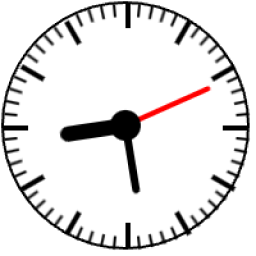
12-Hour vs 24-Hour Time: How to Convert Without Mistakes
Converting between 12-hour and 24-hour time is a two-rule operation that almost everyone learns badly. The rules themselves are simple; what trips people up is the edge case at 12, where both the "add 12" and "subtract 12" instincts are wrong.
Here is the whole system, including the part that causes the errors.
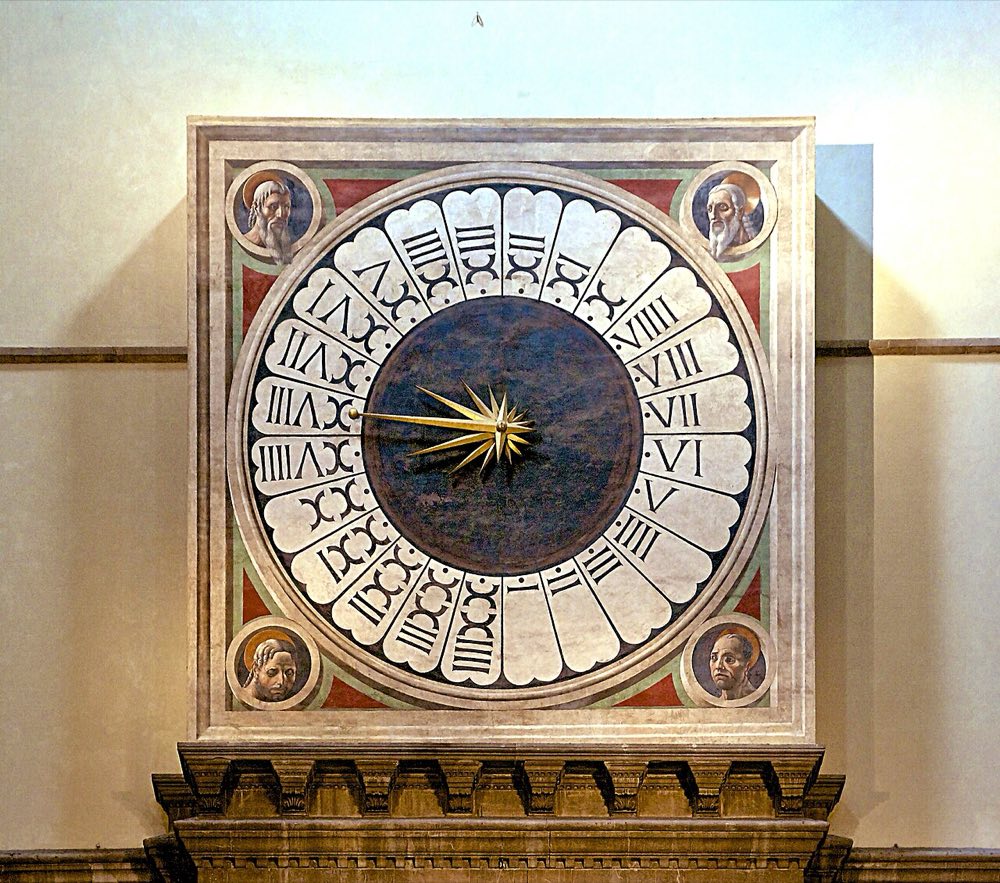
Paolo Uccello's 24-hour clock, Florence Cathedral — CC0 photo, via Wikimedia Commons
The two rules
For any time from 1:00 to 11:59:
- 12-hour to 24-hour, PM: add 12. 3:40 PM becomes 15:40.
- 12-hour to 24-hour, AM: change nothing. 3:40 AM stays 03:40.
- 24-hour to 12-hour: if the hour is 13 or more, subtract 12 and label it PM. If it is 00 to 11, keep it and label it AM.
That covers 23 of the 24 hours. The remaining one is 12, and it does not follow either rule.
The 12 o'clock trap
12 AM is midnight. 12 PM is noon. This is not intuitive, and it is the single most common source of errors in the whole system.
The reasoning: AM means ante meridiem, "before midday". PM means post meridiem, "after midday". Midnight is the instant that begins the day, so it sits at the very start of the "before midday" half — 12 AM. Noon is the instant that ends the morning, so it sits at the start of the "after midday" half — 12 PM.
In 24-hour form:
| 12-hour | 24-hour | What it is |
|---|---|---|
| 12:00 AM | 00:00 | Midnight, start of the day |
| 12:01 AM | 00:01 | Just after midnight |
| 12:00 PM | 12:00 | Noon |
| 12:01 PM | 12:01 | Just after noon |
| 12:00 AM (next day) | 24:00 or 00:00 | End of day / start of next |
So the "add 12 for PM" rule has exactly one exception: 12 PM stays 12. And the "subtract 12 for 24-hour" rule has exactly one exception: 00:xx becomes 12:xx AM, not 0:xx AM.
Full conversion table
| 12-hour | 24-hour | 12-hour | 24-hour |
|---|---|---|---|
| 12:00 AM | 00:00 | 12:00 PM | 12:00 |
| 1:00 AM | 01:00 | 1:00 PM | 13:00 |
| 2:00 AM | 02:00 | 2:00 PM | 14:00 |
| 3:00 AM | 03:00 | 3:00 PM | 15:00 |
| 4:00 AM | 04:00 | 4:00 PM | 16:00 |
| 5:00 AM | 05:00 | 5:00 PM | 17:00 |
| 6:00 AM | 06:00 | 6:00 PM | 18:00 |
| 7:00 AM | 07:00 | 7:00 PM | 19:00 |
| 8:00 AM | 08:00 | 8:00 PM | 20:00 |
| 9:00 AM | 09:00 | 9:00 PM | 21:00 |
| 10:00 AM | 10:00 | 10:00 PM | 22:00 |
| 11:00 AM | 11:00 | 11:00 PM | 23:00 |
Note the symmetry: 1 AM pairs with 13:00, 2 AM with 14:00, and so on up to 11 AM with 23:00. Once you see that the afternoon hours are just the morning hours plus 12, the table collapses into a single relationship.
Who uses which
24-hour time is standard in most of the world for transport, broadcasting, computing, and the military. It is the default written form in most of Europe, Latin America, China, Japan, and Korea. It removes ambiguity entirely — there is no "which 7 o'clock".
12-hour time is the everyday spoken and written form in the United States, Canada (alongside 24-hour in French-speaking contexts), Australia, New Zealand, India, the Philippines, and the UK in casual use. British English often writes "3.40pm" with a dot separator and no space.
Military and aviation use a compressed form: 1500 is read "fifteen hundred", 0900 is "oh nine hundred". Written without a colon, sometimes with a zone suffix such as Z for Zulu time (UTC).
Reading 24-hour time aloud
The main practical difficulty in 24-hour countries is not conversion but speech. A few conventions:
- 00:00 — "zero hundred" or "midnight".
- 09:05 — "oh nine oh five" in military style; in ordinary speech, most languages say "nine oh five" or "nine hours five".
- 15:40 — "fifteen forty", not "three forty PM".
- 24:00 — valid in timetables to mean the end of the day; equivalent to 00:00 of the next.
Common mistakes
- Assuming 12 PM is midnight. It is noon. This is the error that ends up in flight bookings.
- Writing 13:00 PM. Redundant — 13:00 already means afternoon. Pick one system.
- Converting 12:30 PM to 24:30. There is no 24:30. 12:30 PM is 12:30.
- Dropping the leading zero. 09:00 and 9:00 mean the same thing, but sorted as text they do not — "10:00" sorts before "9:00". Use leading zeros in any data that will be sorted.
- Treating 24:00 and 00:00 as different instants. They are the same moment expressed from two directions.
Where this matters in practice
Timestamps, log files, train timetables, and API responses are almost always 24-hour and often UTC. The timestamp converter shows both forms side by side, which is the quickest way to check a value you are unsure about.
If you are adding or subtracting durations across a 12/24 boundary, do the arithmetic in 24-hour form and convert back at the end — it avoids the wrap-around mistake entirely. The time calculator handles this directly.
And for a clock face that shows the same information without any AM/PM question at all, the digital clock can be switched between both formats.