From Shadow to Atom: How We Learned to Measure Time
If you had asked a European peasant in the 14th century how long an hour was, the question would have seemed odd. In his world, an hour had no fixed length. Daylight was divided into twelve parts and darkness into twelve parts. An hour of summer daylight was nearly twice as long as an hour of winter daylight.
The idea that an hour is always 60 minutes, that a day has 24 of them, that each one is exactly the same length — none of that is ancient common sense. It was invented. And the process of inventing it changed how humans understand the world.
The history of timekeeping has a clearer thread than "clocks got more accurate." Three times, we detached time from nature.
First, sundials and water clocks turned the sun's motion into a divisible scale. Second, the escapement let time run without looking at the sky — and equal hours were born in that moment. Third, the second was redefined from the rotation of the Earth to a transition in a caesium atom, and time left astronomy behind entirely.
In October 2026, that story turned another page.
I. The Shadow of the Sun
Before clocks, time was a list of events
The earliest units of time were not hours. They were events: "one stick of incense," "the time it takes to eat a meal," "before sunset," "first crowing." These are still in use, and their defining feature is that their length varies — but that was fine for an agricultural society.
Two problems broke the system: coordination (a religious ceremony has to start at the same moment for everyone) and record-keeping ("three days ago" is not a date). Event time cannot answer either question, so people looked for something stable.
The sun was the obvious candidate.
Cutting the shadow into twelve
One of the oldest surviving sundials is the Egyptian shadow clock, from around 1200 BC. Its design is almost naive: a horizontal bar with a raised plate at one end, and markings along the bar. In the morning the plate faces east and the shadow falls on the western markings; in the afternoon it is reversed. Wherever the shadow lands, that is the hour.
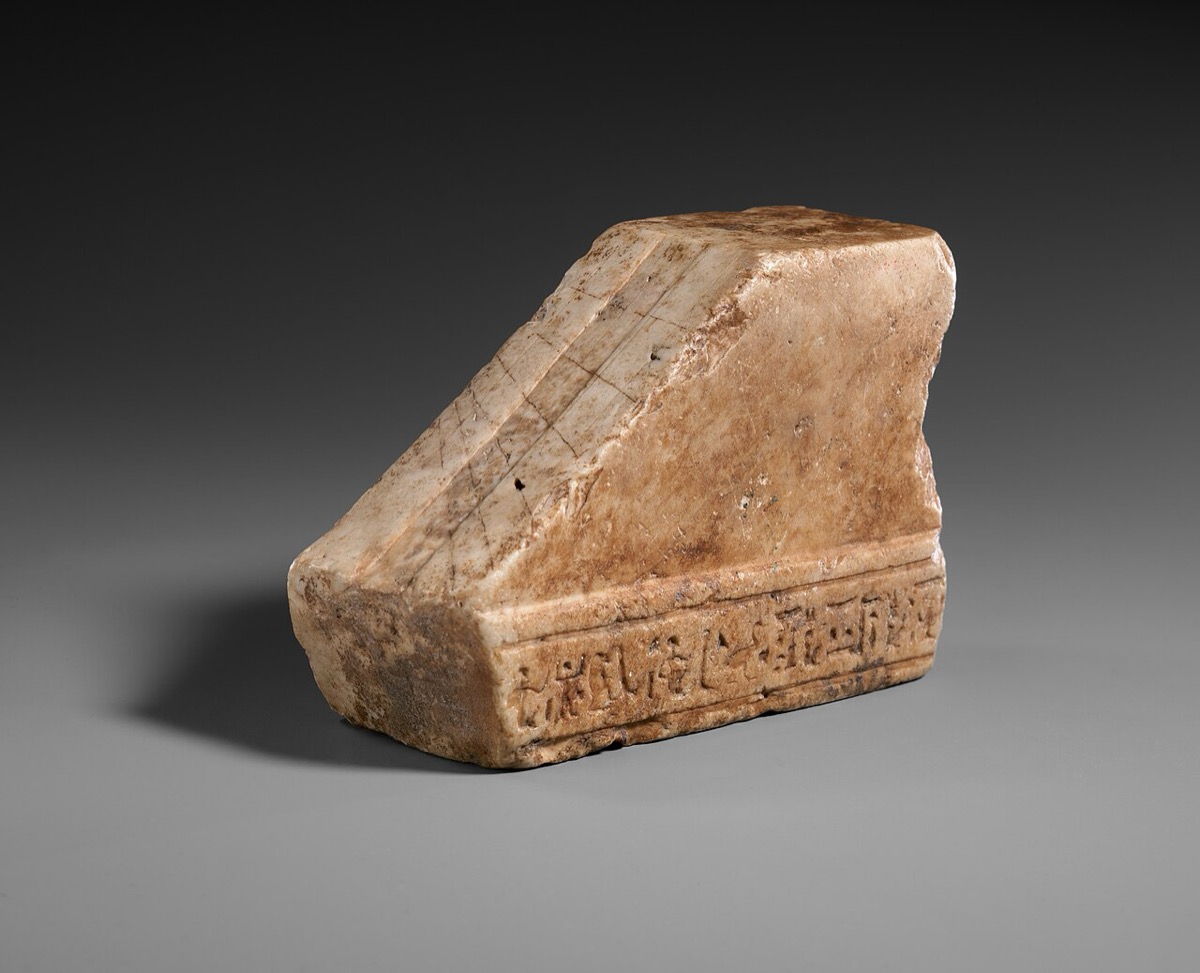
Egyptian shadow clock, limestone. Image: Metropolitan Museum of Art, CC0, via Wikimedia Commons
The Babylonians went further, using a hemispherical bowl as a dial and dividing the path of the shadow into twelve parts. The number twelve was not arbitrary — Babylonian mathematics used base 60, and 12 divides 60 evenly. The 12-hour dial and the 360-degree circle both trace back to Mesopotamia.
China took a different route: the gnomon. A vertical post casts a shadow onto a horizontal scale, and the length of the noon shadow fixes the solstices and the calendar. Sundials proper were used for everyday hours, with the shadow of the style falling on a graduated face.
The Roman mistake
Sundials have a hidden complication: the markings depend on latitude. A dial that works in Rome does not work anywhere else.
Rome learned this the hard way. In 264 BC they looted a sundial from Catania in Sicily and set it up in the Forum. Catania is further south than Rome, so the shadow angles did not match. The dial gave the wrong time — and it stayed wrong for about a century, until someone recalibrated it for Rome's latitude in 164 BC.
The lesson recurs throughout this history: the accuracy of a timekeeping tool is often limited not by technology but by an inconsistent frame of reference.
The fatal flaw
Sundials fail in three ways: clouds, night, and latitude.
The first two forced a new approach. The third became a global political problem two thousand years later — time zones. More on that below.
II. Water, Fire and Incense
Let water walk for the sun
The water clock — clepsydra, Greek for "water thief" — solved the obvious problem: it does not need the sun.
The earliest description dates to around 1500 BC, in the tomb inscription of an Egyptian court official named Amenemhet, who is credited as the inventor. The most famous surviving example comes from the tomb of Pharaoh Amenhotep III.
The principle is simple: water drains through a small hole, the level falls, and the level tells you how much time has passed.
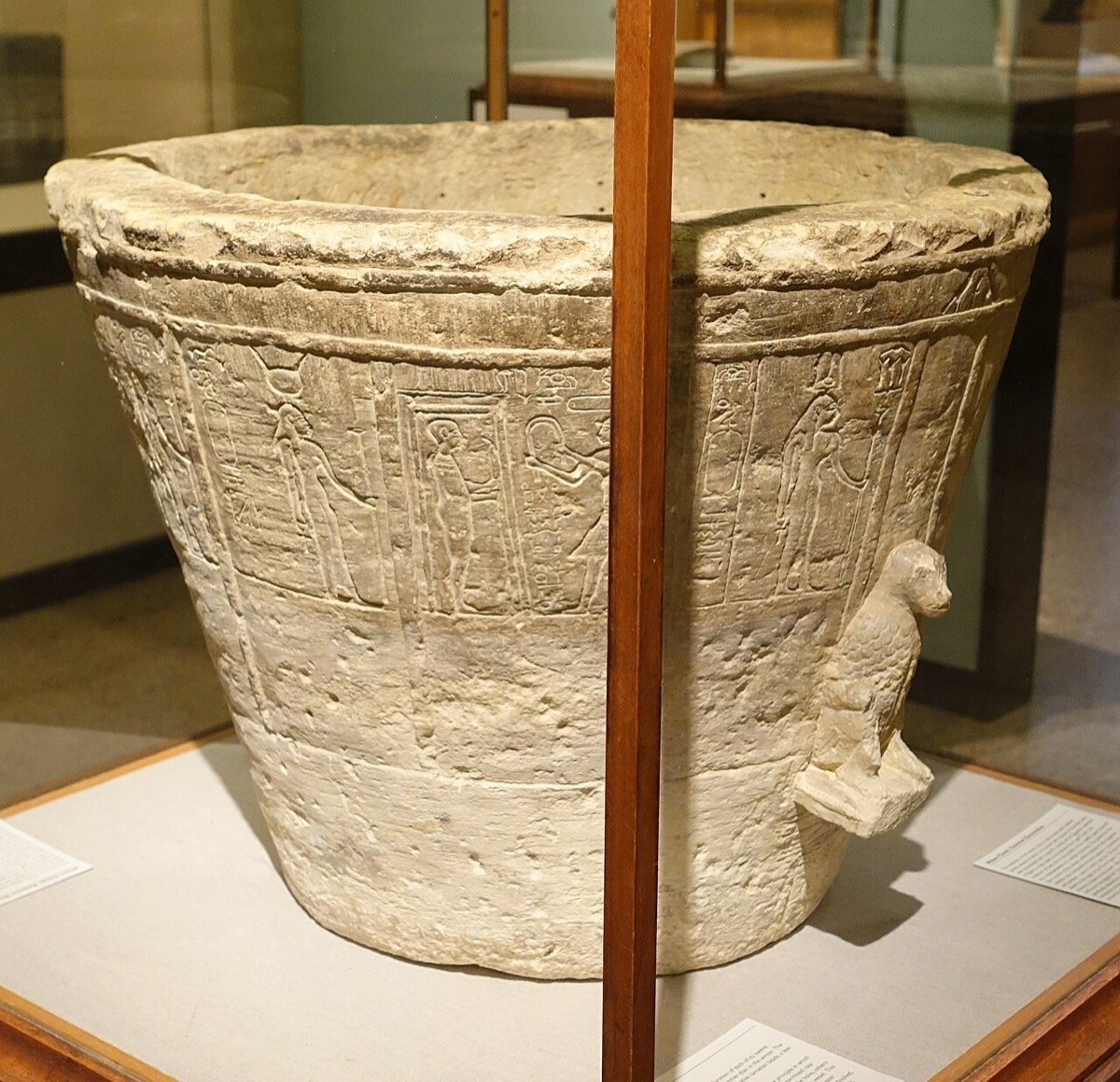
Egyptian water clock, reign of Ptolemy II (285–246 BC), limestone. Image: Oriental Institute Museum, University of Chicago, CC0, via Wikimedia Commons
But the simple design has a physical defect: pressure drops as the water level falls. It flows fast when full and slow when nearly empty. The same interval on the scale represents different durations early and late.
The Egyptians compensated by tapering the vessel — as the level falls, the surface area shrinks, partly offsetting the pressure loss. China's solution was more thorough: keep the level constant. Around 550 AD, Yin Kui described an overflow tank in his Louke Fa; excess water spills out through a side opening, so the level in the main vessel never changes and the flow rate stays stable.
Su Song's astronomical tower
Hydraulic timekeeping in China reached its peak in 1088, when Su Song completed a water-driven astronomical clock tower. It was a wooden structure over ten metres tall, powered by a water wheel, and it did three jobs at once: observing the sky, demonstrating celestial motion, and announcing the time.
Two features stand out. It used a chain drive to transmit power from the water wheel to the armillary sphere at the top — one of the earliest known chain drives. And its time-announcement system sent mechanical figures out to strike bells, beat drums and display tablets, turning "what hour is it" into a public spectacle.
The machine was destroyed in war, but its technical approach — using water to drive a complex mechanism that models the heavens — runs parallel to what European mechanical clocks would later attempt.
Incense, candles and "a while"
China also had cheaper timekeepers: burning incense. A spiral incense coil carried marks, and where it had burned to told you the hour; sticks of incense and candles were often marked the same way. A poem from 520 AD already describes a graduated candle used to tell time at night.
Incense clocks were cheap, portable and needed no maintenance. They were also imprecise and sensitive to drafts. Their real significance is that they made a duration visible: you did not need to know what time it was, only how long was left.
The shared ceiling
Water clocks, incense and candles all share a limit: they measure elapsed time but cannot indicate the current time.
A water clock tells you that two hours have passed. It does not tell you that it is the third hour of the afternoon. For that you still needed the sun. The first technology to do both — continuous measurement and direct indication — was the mechanical clock.
III. An Hour Was Not Always Equal
Before the mechanical clock, we have to be clear about "temporal hours," or the system would make no sense.
Romans and medieval Europeans divided daylight into twelve parts and darkness into twelve parts. An "hour" was a proportion, not a fixed quantity: in summer the daylight hour was long, in winter it was short. Across the year, a daylight hour could range from roughly 45 to 75 minutes.
Why divide time this way? Because the system served religion. A monastery had seven offices a day — matins, lauds, terce, sext, none, vespers, compline. These were defined as points in the day, not as intervals from midnight. If prayer must happen at a particular position of the sun, unequal hours are the sensible choice.
Under that system, ordinary people did not need precise time. "Morning," "noon" and "evening" were enough. The church bell told you what to do next. Time was a public broadcast, not personal property.
The turn came in the 13th century, when sundial scales began to appear in equal divisions — 24 hours of uniform length. This was not because people suddenly preferred neatness. It was because a new machine needed a constant unit: the wheels and foliot of a mechanical clock do not change speed with the seasons.
Equal hours were not discovered by clocks. They were imposed by them. This is the most counter-intuitive and most important step in the whole history.
IV. The Escapement
It is not the gears
People assume the essence of a mechanical clock is its gears. But gears had been used for centuries before clocks — in water mills, windmills and cranes.
The actual invention was the escapement. It does one thing: it converts continuous rotation into a series of equal pulses.
Think of it this way. A weight pulls on a cord and the wheel train wants to spin freely. The escapement is a gate: it catches the wheel, lets it advance by exactly one tooth, catches it again. Every click is one fixed unit of time.
The verge-and-foliot escapement, which appeared around 1275, was the first regulator in horology. It was not accurate, but it let a machine count time by itself for the first time.
Why monasteries
The first mechanical clocks appeared in monasteries, and that was no accident. A monastery needed to pray on time, water clocks froze in winter and needed constant refilling, and sundials were useless under cloud. A machine that ran on its own and needed no maintenance was a genuine need.
One of the earliest recorded large mechanical clocks is the tower clock at Norwich Cathedral in 1273 — only the payment record survives, not the clock. In 1336 Milan had the first known clock that struck the hours regularly. In 1344 the old St Paul's Cathedral in London replaced its clock with one using an escapement.
How bad were they
These clocks were extremely inaccurate, and it is worth being explicit about it.
The most famous example is the clock Henry de Vick built for the royal palace in Paris around 1360. Its daily error could reach two hours. This was not sloppy workmanship; it was the physical limit of the escapement. The verge escapement has no isochronism — changes in driving force, friction or temperature directly change the rate.
Two hours of error was not fatal at the time, because people did not want "the time is 3:47." They wanted "it is time to pray" or "it is time to start work." A clock was for announcing, not measuring.
The clock tower becomes infrastructure
Between 1371 and 1380, more than 70 European cities installed public clocks. Stop and consider that number: seventy cities in under a decade.
Clock towers changed urban life. Working hours came to be marked by bells; market opening, curfews and the artisan's day all followed the clock. Time moved from being the church's property to the city's, and later to the individual's.
One of the oldest surviving working mechanical clocks is the Salisbury Cathedral clock of 1386. It retains its medieval verge escapement and foliot — the horizontal bar with weights at each end whose oscillation regulates the speed.
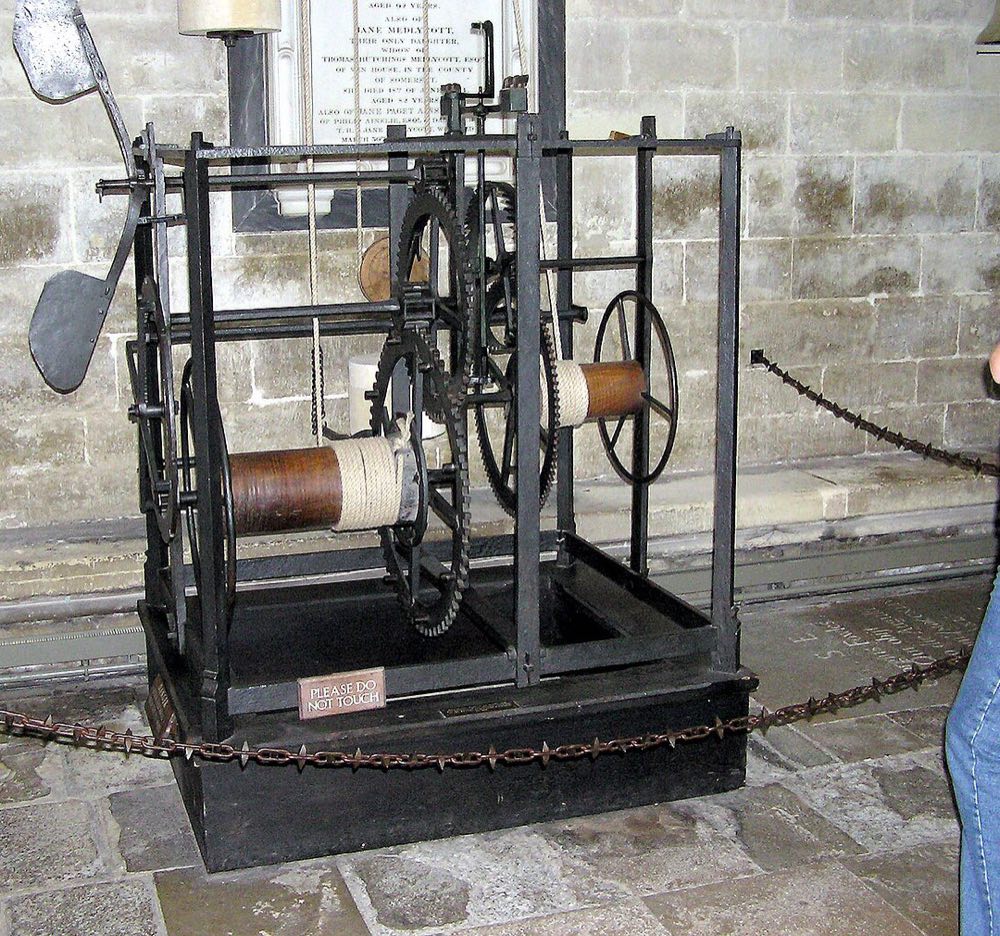
Salisbury Cathedral clock (c. 1386), one of the oldest working mechanical clocks. Image: Adrian Pingstone, public domain, via Wikimedia Commons
The Wells Cathedral clock of 1392 went further, keeping its original medieval dial along with jousting knights that circle every quarter hour.
Astronomical clocks
From the 14th to the 16th century, European cities competed to build astronomical clocks. These did not just show the time; they showed the phase of the moon, planetary positions, the zodiac, the solstices and religious feast days. The Strasbourg Cathedral clock is the most famous, and a 1574 engraving records its structure.
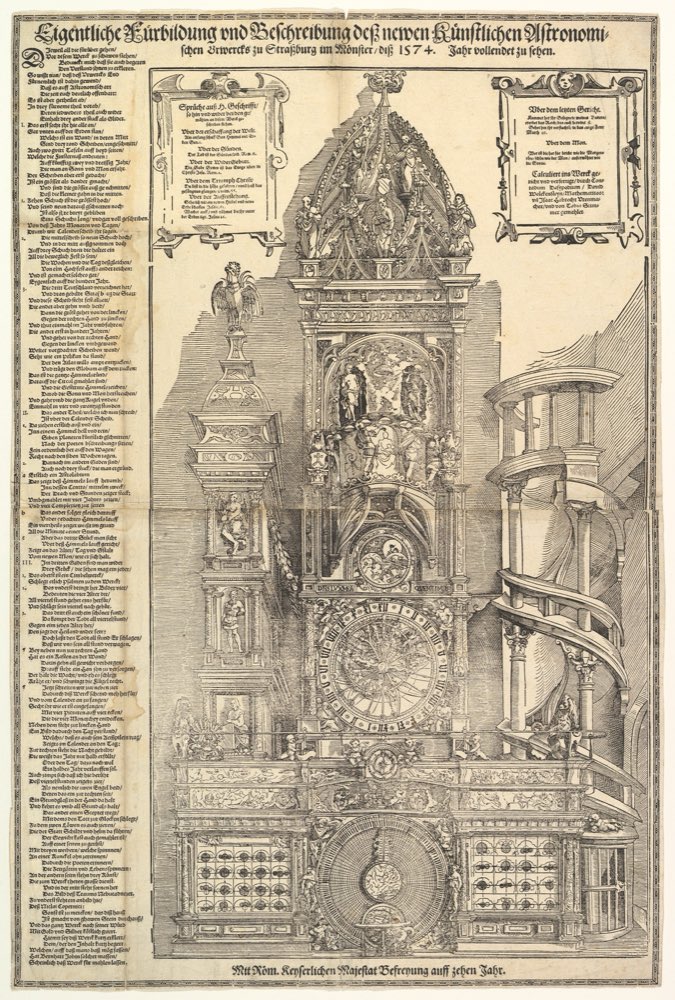
Strasbourg Cathedral astronomical clock, 1574 engraving. Image: Metropolitan Museum of Art, CC0, via Wikimedia Commons
An astronomical clock was a statement: time is not an isolated number, it is bound to the motion of the heavens. That idea survived until the 19th century, when the railways pulled time down out of the sky.
Minute and second hands came later
An easily overlooked fact: most medieval clocks had only an hour hand.
A manuscript from 1475 first mentions a clock with a minute dial. In 1577 Tycho Brahe acquired some of the first clocks capable of reading seconds. Second hands only became common in the 1690s, once the balance spring had improved accuracy enough for seconds to mean anything.
In other words, "the time is 3:47" entered daily life about two centuries after "the time is 3."
Going portable
Around 1510, the Nuremberg locksmith Peter Henlein produced small clocks that could be carried. In 1524 he was paid for making an early watch, which is generally treated as the beginning of the portable timepiece.
One correction to a widely repeated story: the name "Nuremberg egg" was applied later. The surviving objects were not necessarily egg-shaped, and historians have argued about the term for a long time.
V. Pendulums and Springs
Galileo's observation
In 1583, Galileo noticed a swinging lamp in Pisa Cathedral: whether the swing was wide or narrow, the time per swing seemed the same. This is the isochronism of the pendulum.
What made the observation valuable was that it offered a natural period. Gears wear, weights lighten, but a pendulum of a given length has a fixed period.
Huygens built the clock
On 25 December 1656, the Dutch scientist Christiaan Huygens built the first pendulum clock.
The numbers tell the story. Before the pendulum, the best mechanical clocks drifted by about 15 minutes a day. The pendulum brought that down to about 15 seconds a day. A sixty-fold improvement in one step — the largest single gain in the history of timekeeping.
Improvements then ran along two lines.
One was the escapement. Around 1658 Robert Hooke devised the anchor escapement, cutting the pendulum's swing from 80–100 degrees to 4–6 degrees. A smaller swing means better isochronism and a steadier rate. In 1675 Richard Towneley invented the deadbeat escapement, popularised by George Graham around 1715, which became standard in precision clocks.
The other was temperature. Metals expand when heated, the rod lengthens, and the clock runs slow. In 1721 Graham invented the mercury pendulum: as the rod expands, the mercury also expands and its surface rises, moving the centre of mass back up and cancelling the error. In the 1720s John Harrison built the gridiron pendulum, using two metals with different expansion rates to hold each other in check. These compensations pushed temperature error down to the point of irrelevance.
By the mid-18th century, the best precision pendulum clocks were accurate to a few seconds per week.
The longitude problem
Pendulums solved accuracy on land and failed completely at sea.
Three reasons: a ship rolls, so the pendulum cannot swing steadily; the period depends on gravity, which varies with latitude by about 0.5% between equator and pole; and the sea's temperature and humidity swings defeat the compensation mechanisms.
And the sea is exactly where precise time mattered most, because longitude is time. The Earth turns 15 degrees per hour. If you know the difference between local noon and the time in Greenwich, you know your longitude. Four seconds of error is about one nautical mile of position.
In 1707 a British fleet miscalculated its longitude and ran onto the Scilly Isles; four warships sank and nearly two thousand men died. That disaster led directly to the Longitude Act of 1714, which offered up to £20,000 for a practical method of finding longitude at sea.
Harrison's H4
John Harrison, a carpenter by trade, took up the challenge. He built four machines: H1 (1735), H2 (1741) and H3 (1759) were all too large and heavy. H4 (1761) was about 12 centimetres across, shaped like a large pocket watch, and used a fast-beating balance with a temperature-compensated spiral spring — a shift from "pendulum clock" to "portable oscillator."
On 18 November 1761, H4 sailed for Jamaica aboard HMS Deptford. The voyage took 81 days and 5 hours. On arrival at Kingston, compared against the known longitude, the watch was 5 seconds slow — about 1.25 arcminutes, roughly one nautical mile.
That was three times better than the prize required.
Harrison did not receive the £20,000. The Board of Longitude repeatedly challenged him and demanded he dismantle and disclose his design. He eventually received about £23,065 in instalments and never the official full prize. The dispute is itself a recurring theme in the history of technology: technical breakthroughs and political settlements rarely move at the same speed.
The limit of the pendulum
Pendulum clocks remained the most accurate timekeepers in the world for over two centuries. In 1923 the Shortt free pendulum clock reached better than one second per year, the most precise commercial pendulum clock ever built.
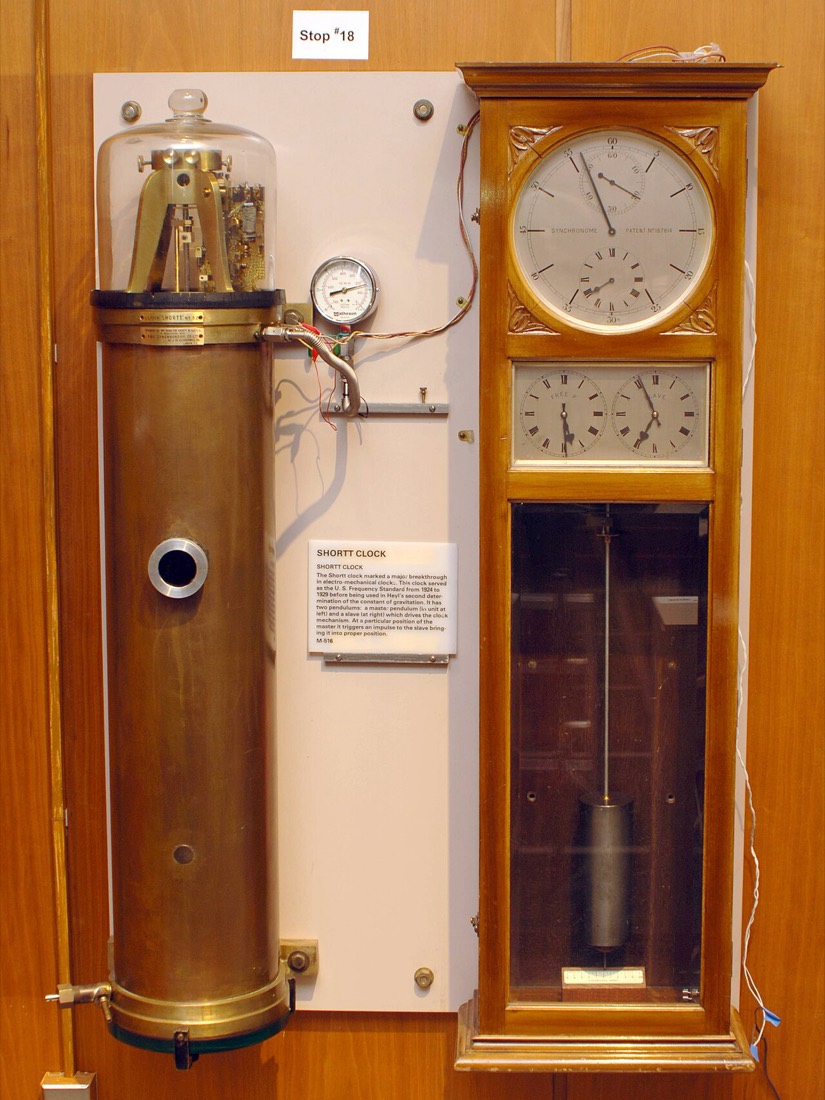
Shortt free pendulum clock (1923), accurate to better than a second per year. Image: public domain, via Wikimedia Commons
From 1656 to 1927, the pendulum ruled timekeeping for 270 years.
VI. Making Time Uniform
Every town had its own noon
Once clocks were accurate, a new problem surfaced: clocks in different places disagreed.
This was normal. When noon is defined as the moment the sun is highest, every town has a different noon. London and Bristol differ by about 10 minutes; London and Liverpool by about 12. In the age of horse transport, that did not matter — you could not cover the distance in a day anyway.
The railway changed everything.
Railway time
In 1840 the Great Western Railway became the first to standardise on London time across its whole network. The reason was practical: a timetable cannot accommodate a dozen local times without passengers miscalculating their connections.
On 18 November 1883, American railways divided North America into four zones and adopted "railway standard time." The day became known as "the day of two noons" — many towns experienced noon twice.
The 1884 Washington conference
In October 1884, delegates from 25 nations met in Washington to choose a single prime meridian. The main candidates were Greenwich and Paris.
Greenwich won not on science but on coverage: two-thirds of the world's shipping already used charts based on Greenwich. Changing the reference would have meant reprinting the world's nautical charts.
The conference established the Greenwich prime meridian and the framework of hourly zones. But note: it only recommended. Adoption took decades. France did not formally adopt the Greenwich reference until 1911.
Time zones are legislation, not geometry
Today's time zones look natural but are political choices.
China spans about five geographic hours yet uses a single offset, UTC+8. In western Xinjiang the sun can rise around 10 a.m. Spain sits geographically at roughly UTC+0 but uses UTC+1 to align with central Europe. India uses UTC+5:30 and Nepal UTC+5:45 — the only 45-minute offset in the world.
None of these are astronomical facts. They are legislative ones. Remembering that saves a lot of confusion about what "UTC+8" actually means.
The clock in the station
The most visible legacy of the railway age is the large clock in the station. It is not just a timekeeper but a public promise: this clock's time is the line's standard time.
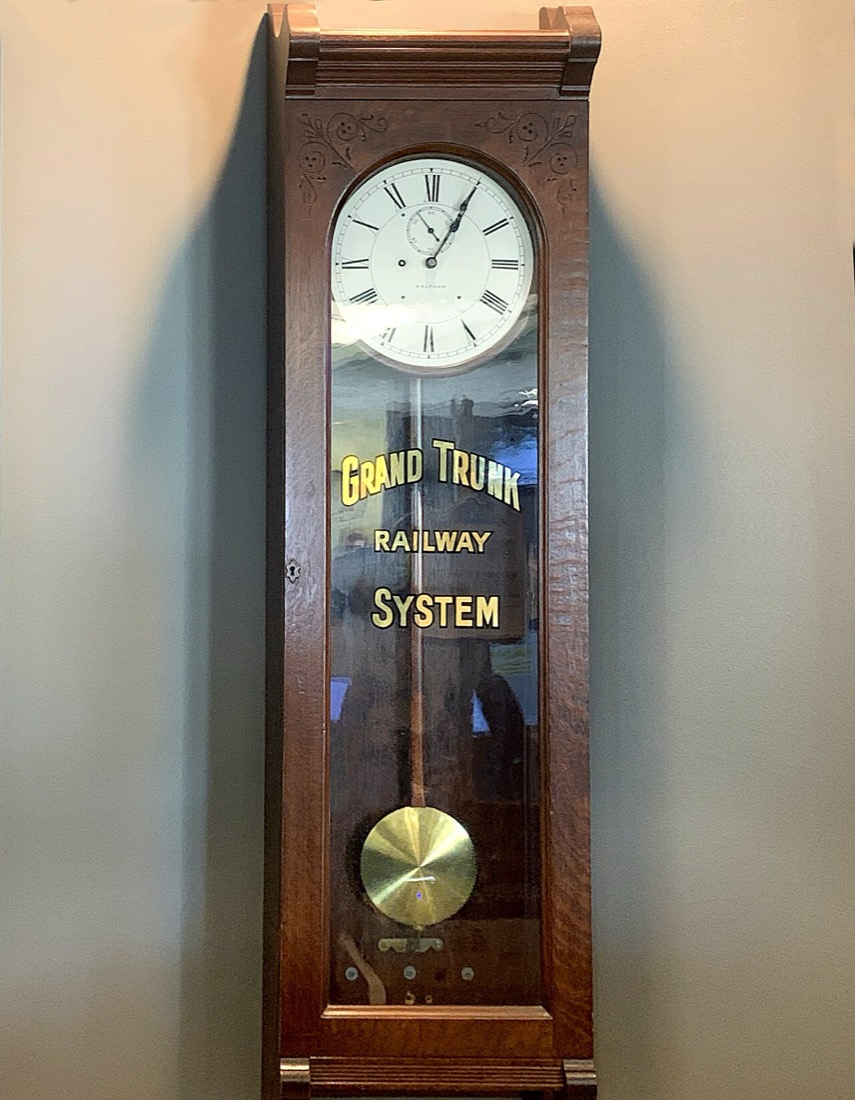
Grand Trunk Railway station clock, Kingston, Canada. Image: Mr Serjeant Buzfuz, CC0, via Wikimedia Commons
VII. From Quartz to Atoms
Quartz: let a crystal vibrate
In October 1927, Horton and Marrison at Bell Labs built the first quartz clock. It exploits piezoelectricity: apply a voltage to a quartz crystal and it vibrates at an extremely stable frequency — 32,768 times a second in the value later common in watches, or far higher.
Quartz immediately outperformed the best pendulum clocks, needed no pendulum, tolerated vibration, and could be made small. In 1969 Seiko released the Astron, the first quartz wristwatch. Within two decades, quartz had pushed mechanical watches out of the mass market.
Atoms: let physics keep time
In 1949 the first atomic clock prototype was built, using a transition in the ammonia molecule.
In 1955, Louis Essen and Jack Parry at the UK National Physical Laboratory built the first practical caesium-beam atomic clock. It used the microwave frequency emitted when caesium-133 atoms transition between two energy levels — a frequency fixed by physics, immune to temperature, pressure and wear.
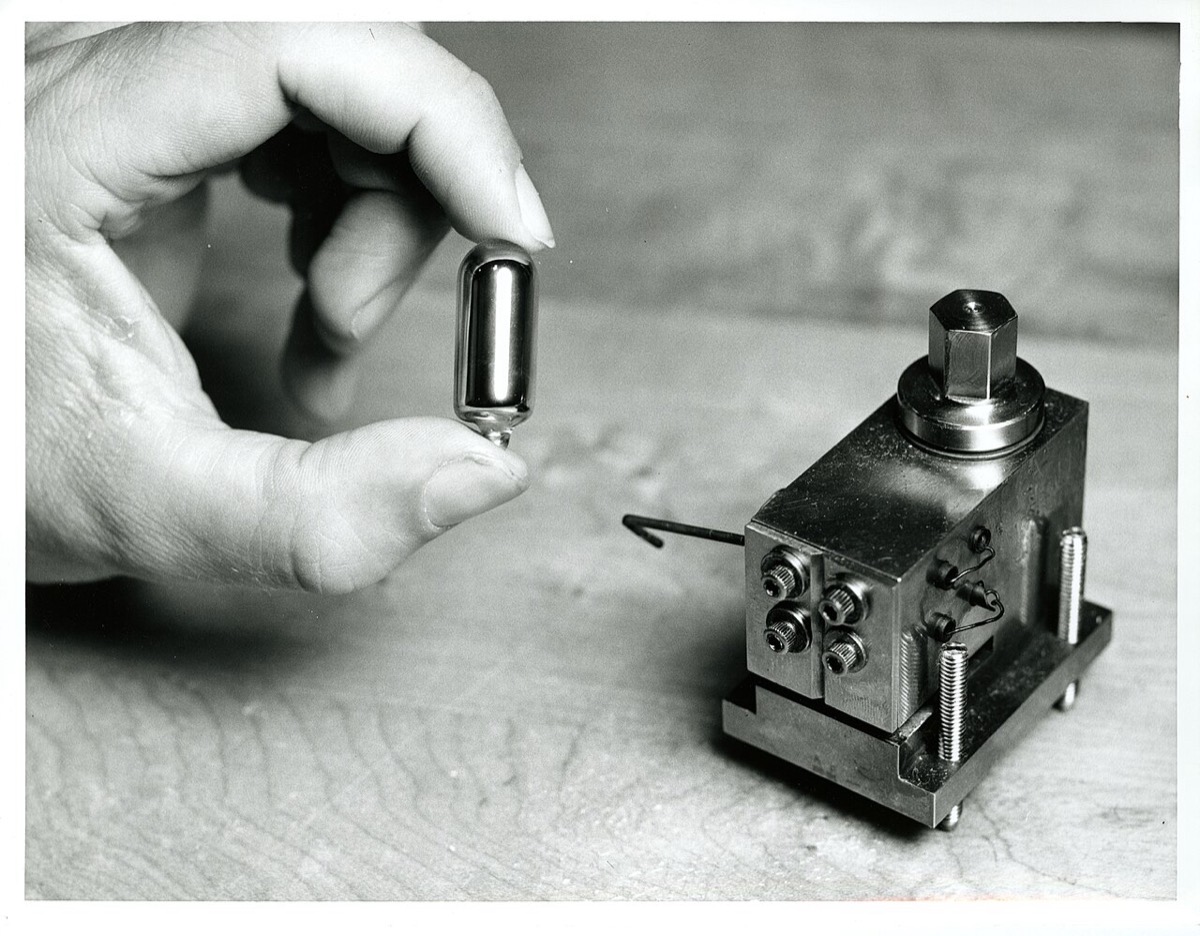
Caesium capsule and beam apparatus of an early atomic clock, US National Bureau of Standards. Image: public domain, via Wikimedia Commons
In 1967 the 13th General Conference on Weights and Measures made the decisive change: the second would no longer be defined by the Earth's rotation, but as 9,192,631,770 periods of the radiation corresponding to the transition between two hyperfine levels of the ground state of caesium-133.
This was the third and most complete detachment. Time no longer depended on any celestial body — only on an atom.
Leap seconds: a patch that is ending
Atomic time is extraordinarily stable, but the Earth's rotation is not. It is slowing, and it wobbles.
To keep clock time and astronomical time aligned, the leap second was introduced in 1972: when the two drift close to 0.9 seconds apart, a second labelled "23:59:60" is inserted at the end of 30 June or 31 December.
From 1972 to 2016, 27 leap seconds were added, the last on 31 December 2016. None have been added since, so the offset between International Atomic Time and UTC has been fixed at 37 seconds.
Leap seconds caused real problems for computing. In 2012 a leap second sent CPU usage soaring on large numbers of Linux servers; in 2016 some Cloudflare services misbehaved. The reason is that "23:59:60" occurs twice on the timeline, while most software assumes time only moves forward.
Hence the turning point.
On 15 October 2026, the 28th General Conference on Weights and Measures, meeting at Versailles, voted to abolish the leap second. From 20 May 2027 — World Metrology Day — a "Continuous UTC" takes effect: UTC will no longer add or remove seconds to track astronomical time, and the permitted drift between the two widens from 0.9 seconds to 3,600 seconds, one hour.
Behind the decision is a concrete worry: the Earth's rotation has recently been speeding up, and the probability of a negative leap second — deleting a second — is rising. Positive leap seconds have precedent; a negative one has never happened, and it would pose an entirely new risk to systems that depend on continuous time. Better to leave the mechanism before that day arrives.
From 1972 to 2027, the leap second will have lasted 55 years. It is one of the few timekeeping institutions in history to be deliberately retired.
VIII. Time Is Not Absolute
Newton's absolute time
Newton was explicit in the Principia: absolute time "of itself, and from its own nature, flows equably without relation to anything external."
That assumption underpinned all of classical physics, and it matches intuition. If a clock is wrong, the clock is the problem; time itself does not change.
Einstein's correction
In 1905, special relativity gave a different answer: simultaneity is relative. Whether two events happen "at the same time" depends on the observer's motion. The faster you move, the slower your time runs.
This is not a thought experiment. In 1971, Hafele and Keating flew four caesium clocks around the world on commercial airliners and compared them with clocks on the ground. The results matched the relativistic prediction — clocks flying east ran slow, clocks flying west ran fast, because of the Earth's rotation.
GPS proves it every day
GPS is the largest everyday application of relativity.
GPS satellites orbit at about 20,200 kilometres and move at about 3.9 kilometres per second. Special relativity says their clocks run slow (about 7 microseconds a day); general relativity says that because gravity is weaker up there, their clocks run fast (about 45 microseconds a day). The net effect is that a satellite clock gains about 38 microseconds a day relative to the ground.
Thirty-eight microseconds sounds negligible, but light travels about 11 kilometres in that time. Without pre-correcting for it, GPS positions would drift by more than ten kilometres a day — useless within hours.
The reason your phone can navigate is that relativity is built into the system.
Optical clocks: measuring a difference in height
Today's best optical clocks reach an uncertainty around 10⁻¹⁸.
What does that mean? Place two such clocks on the floor and on a table one metre higher, and the tiny difference in gravitational potential produces a measurable difference in their rates — a difference in height of one centimetre is detectable.
This is no longer just a better clock. It is a new kind of instrument: measure the time difference and you measure gravity, and from gravity you measure elevation, groundwater, volcanic deformation.
Epilogue
Go back to that peasant. To him, an hour was an arc of the sky, long in summer and short in winter, and there was nothing strange about that.
Today we say an hour is 3,600 seconds, and a second is 9,192,631,770 cycles of a caesium transition. The definition is precise enough that it would not drift by a second over a span as long as the age of the universe.
But the more precise our clocks became, the clearer it got that time is not a uniform thing flowing independently of the world. It stretches with speed, compresses under gravity, and changes with the observer's motion.
Humans spent millennia taking time away from the sun, putting it into clocks — and then discovered that a clock measures its own relationship with the world, not an absolute time behind it.
That is probably the most interesting ending this history could have.
References
- 13th CGPM (1967), Resolution 1 – SI unit of time (second): the second as 9 192 631 770 periods of the caesium-133 hyperfine transition
- 28th CGPM (2026), Resolution 5 – On the technical actions needed to ensure the continuity of UTC: abolishing the leap second and adopting a continuous UTC
- History of timekeeping devices: from sundials to atomic clocks
- Leap second: how leap seconds work and every adjustment so far
- NIST – Leap Seconds FAQs: official explainer from the US National Institute of Standards and Technology