Sleep Cycles and the Best Time to Sleep: Does the 90-Minute Cycle Hold Up?
Set your alarm for 7:00, count back five 90-minute blocks, and you land on 23:30. Nearly every sleep calculator opens with that answer.
Behind the number are three different things: a real discovery, a flattened average, and a promise that has never been tested. This article separates them.
The short version: "the 90-minute rule" is not a scientific term. It does not appear in the literature, and it is not in sleep medicine textbooks. It comes from a popular book written for athletes, and somewhere along the way it acquired the word "rule." The cycle is real. The 90 is an average. And the claim that sleeping in multiples of 90 leaves you clear-headed has no evidence behind it.
I. Where the Number Comes From
In 1953, Eugene Aserinsky and Nathaniel Kleitman recorded periodically recurring rapid eye movements in sleeping infants and tied them to changes in the electroencephalogram. Before that, sleep was treated as one uniform state. After it, sleep became two states taking turns. This is the starting point of modern sleep science.
Polysomnography breaks a night into a sequence of N1, N2, N3 and REM. The sequence is not random: non-REM and REM sleep alternate, forming a biological rhythm with a period shorter than a day. The technical name is an ultradian rhythm.
The "90 minutes" is the population average of that rhythm.
An average is not a constant. Feinberg and Floyd analysed cycle structure across whole nights in 1979 and found that in roughly 70% of subjects, individual cycles ran up to 20 minutes longer or shorter than that person's own mean; in the remaining 30% the spread was larger still. That is not measurement error. It is a property of the cycle.
A second analysis by Feinberg in 1974 gave the direction. Splitting subjects into six age groups (mean ages from 7.4 to 77.3 years) and scoring night by night, cycle by cycle, he found that REM period duration increased from cycle 1 to cycle 3, then levelled off — and in the oldest group, the first REM period was already as long as the ones that followed. The "short early, long late" gradient that young adults show is itself age-dependent.
So "a cycle is 90 minutes" drops at least two pieces of information: it is a mean, and the mean is not stationary across the night.
"R90" has an entirely different origin. It comes from Sleep (2016) by Nick Littlehales, a sleep coach who has worked with professional footballers and Manchester United. That is an operating manual for athletes, not a research paper, and it advances no testable hypothesis. The advice is to arrange sleep in multiples of 90 minutes. That is a heuristic, not a finding. Calling it a "rule" — in English or in Chinese — moves it one step further than the source does.
II. What a Night Actually Looks Like
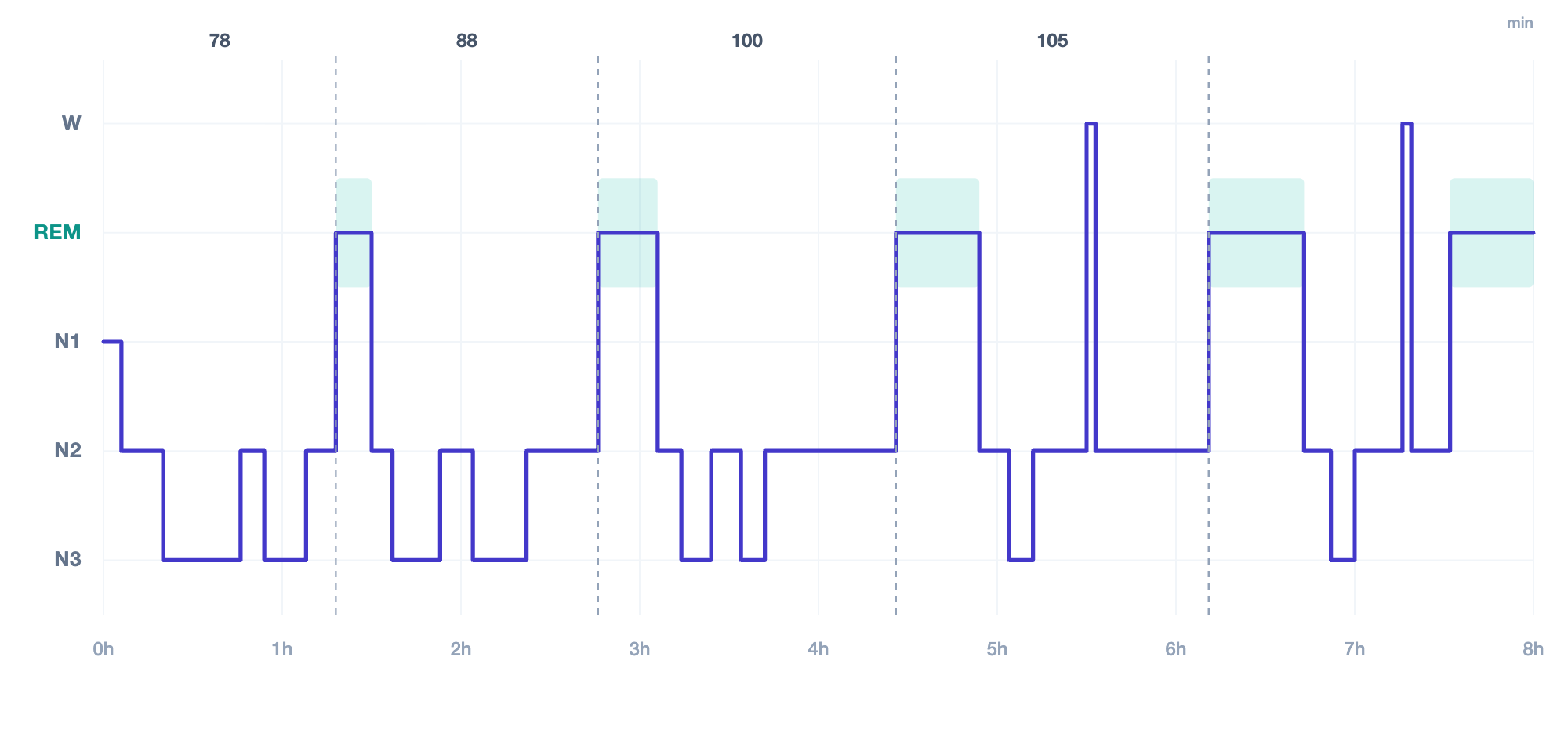
None of the four numbers in that figure — 78, 88, 100, 105 — is 90. That is the point of the figure.
To be clear about what it is: a schematic, not one person's recording. The cycle lengths and stage distribution are drawn from the across-the-night trends reported in the literature, to show structure. It cannot be used to work out your own timetable for tonight.
Three things are visible in it.
Deep sleep is almost entirely front-loaded. N3 occupies most of the first three hours after sleep onset, then drops away quickly. This is the window when physical repair and growth hormone release are concentrated.
REM gets longer towards morning. The first REM period lasts a dozen minutes or so; the last can exceed forty. So "two hours less sleep" is not "a bit less of everything" — what you cut is overwhelmingly REM.
A real night is not a clean staircase. The two brief awakenings in the figure (the trace jumping up to W) are normal. Most people have several arousals a night lasting seconds to minutes, and do not remember them.
One thing the figure cannot show: cycle length differs from night to night. Yesterday's sleep debt, today's activity, alcohol and room temperature all rewrite it.
III. Why You Are Still Groggy
The grogginess, dullness and poor concentration after waking have a name: sleep inertia.
Hilditch and McHill's 2019 review lays out its time course precisely:
- the most significant effects occur within 30 minutes of waking;
- performance usually returns to pre-sleep levels within 30 minutes, sometimes as soon as 15;
- but full recovery takes at least an hour;
- subjective alertness keeps improving for up to 2 hours, while impairment on an addition task takes up to 3.5 hours to dissipate.
Several things amplify it, and none of them is "which cycle you are in":
Sleep debt. Under chronic sleep restriction (5.6 hours of sleep opportunity per 24 hours) compared with an 8-hour control, performance immediately on waking was 10% worse.
Circadian phase. In the review's words, sleep inertia effects are greatest during the biological night, near the circadian low in core body temperature. Being woken at 3 a.m. is far worse than being woken at 3 p.m. — and that has nothing to do with cycle counting.
Sleep stage — the most famous claim, and the messiest evidence. On one side: Stampi reported a 41% reduction in performance on waking from slow-wave sleep, while people woken from N2 performed about the same as people who were already awake. On the other: in Lovato's study, 91% of participants woke from slow-wave sleep with more than half of the preceding sleep period containing slow-wave sleep, and no performance impairment was observed. The review's own conclusion is that it is currently difficult to reach a clear conclusion about the role of slow-wave sleep in sleep inertia.
One more point that is routinely missed: sleep inertia does not require sleep deprivation. It appears even after a full eight hours and a spontaneous waking at the usual time, and lasts at least an hour.
One sentence from the review deserves to stand alone:
While following these guidelines can reduce the risk of sleep inertia … they do not guarantee a sleep inertia-free wake up.
IV. Why "Wake at the End of a Cycle" Cannot Be Executed
The idea sounds reasonable: cycles are 90 minutes, so wake at the end of the fourth or fifth and skip the deep sleep. The problem is that it needs four preconditions, and none of them holds.
First, you do not know tonight's cycle length. Feinberg and Floyd's figure is a 20-minute spread in 70% of people. Accumulated over five cycles, the error at the end can exceed an hour. The "end of a cycle" you calculated from 90 minutes may land in the middle of the fourth.
Second, you do not know when you fell asleep. Calculators assume 15 minutes. Real sleep latency varies nightly: caffeine earlier in the day, a meeting tomorrow, how much you slept the night before all move it. Clinically, under 30 minutes is generally treated as normal — which means the value itself has half an hour of room to move.
Third, sleep is not a set of discrete blocks. You turn over, you wake briefly, you go back under. At the moment the alarm goes off you may be in any stage — including the deep sleep you thought you had avoided.
Fourth, consumer devices cannot measure sleep stages. Watches and rings infer from heart rate variability and movement, not from EEG. They produce estimates, not staging. Asking one to tell you precisely that you are at the end of a cycle is beyond what it does.
The deeper problem is none of those four. The strategy assumes that the sleep stage you are woken from determines how clear-headed you feel — and the previous section showed that the evidence for that assumption is contradictory.
V. What Actually Determines When You Should Sleep
Sleep is regulated by two processes. This is Borbély's two-process model from 1982, and it remains the main framework:
Process S (sleep homeostasis): the longer you are awake, the more sleep pressure accumulates. Sleep discharges it.
Process C (circadian rhythm): an endogenous rhythm driven by the suprachiasmatic nucleus, with a period slightly longer than 24 hours, recalibrated daily by light.
Your best time to fall asleep is where those two curves intersect — not a multiple of 90 minutes. Czeisler and colleagues demonstrated in Science in 1980 how much this matters: with sleep duration held constant at eight hours, both the duration and the organisation of sleep depended on which circadian phase the sleep episode fell in. Same length, different position, different structure.
So the practical anchor is your wake time, not your bedtime. Three reasons:
Wake time determines when you first get bright light, and light is the strongest signal for setting the clock. Fix the wake time and bedtime converges on its own. The reverse does not happen.
Regularity has independent value. Windred and colleagues, in a 2024 prospective cohort of roughly 60,000 UK Biobank participants, found that the Sleep Regularity Index predicted all-cause mortality more strongly than sleep duration. "Same time most nights, same time most mornings" matters more than whether you got seven hours or eight.
Then there is social jetlag. Wittmann and colleagues introduced the term in 2006: the difference in sleep midpoint between workdays and free days. Sleeping two hours later on the weekend shifts your clock two hours back, and Monday morning becomes a transmeridian flight. You can repay the hours. You cannot repay the phase.
VI. What This Site's Sleep Calculator Actually Computes
Since this article lives on clockhub, its own arithmetic should be on the table.
The constants in the sleep calculator are these:
SLEEP_CYCLE_DURATION = 90
Cycle length is fixed at 90 minutes. Cycle count is rounded:
calculateSleepCycles = Math.round(sleepMinutes / 90)
Working back from wake time to bedtime subtracts a fixed 15-minute sleep-onset buffer:
adjustedBedTime = bedTime - 15 * 60 * 1000
Stage breakdown is allocated at a fixed rate per cycle: 20 minutes deep, 25 minutes REM, 45 minutes light.
Against the previous sections, it is now easy to say which outputs to trust.
Trustworthy: the sleep-duration ranges by age. The eight bands in the tool — newborn 14–17, infant 12–15, toddler 11–14, preschool 10–13, school-age 9–11, teen 8–10, adult 7–9, older adult 7–8 hours — match the National Sleep Foundation's 2015 groupings, and the adult 7–9 band is compatible with the 2015 joint consensus of the American Academy of Sleep Medicine and the Sleep Research Society (regularly seven hours or more for healthy adults). This column has a source.
Trustworthy: the window worked back from your wake time. As rough planning, the range it produces is sound — provided you treat it as a range and not a point.
Illustrative only: the cycle count. Because cycle length is not a constant 90 minutes, Math.round returns an approximation. Its value is telling you "about four or five cycles," not "you will wake exactly at the end of the fifth."
Illustrative only: the deep / light / REM minutes. Real stage proportions shift across the night — more deep sleep early, more REM late — and a fixed 20 / 25 / 45 split is what is left after that variation has been averaged away. Good for building intuition. Not good for auditing last night.
Illustrative only: the sleep quality score. It is a weighted score across duration, age, subjective quality, lifestyle and environment. It is not a clinical instrument.
The right way to use it: as a window calculator, not a stage predictor.
VII. A Version That Works
Pulling the above into something executable:
1. Fix your wake time, seven days a week. This is the only anchor that needs precision. Try not to push it more than an hour later at weekends.
2. Set a sleep window from your age band, not a point. For adults, 7–9 hours. Your actual need sits somewhere in that range; find it by trial, not by calculation.
3. Use 90 minutes as a granularity, not a target. Work back to 7.5 and 9 hours as two candidates and allow half an hour of slack either way. Its job is to turn "what time tonight" into a two-way choice, not to promise a clean waking.
4. Allow a sleep-onset buffer, and accept that it varies. Fifteen minutes is a common value, not your value. You only need a rough sense of how long you usually take.
5. Get light within 30 minutes of waking. Open the curtains, or walk outside for ten minutes. This does more for stabilising your schedule than any cycle-alignment trick.
6. Do not make "a whole number of cycles" the goal. Sleeping enough and sleeping regularly both have solid evidence behind them. Aligning cycles does not.
7. Do the caffeine arithmetic in advance. Half-life is around five hours; the afternoon cup still has a quarter of its dose in you at midnight.
When to see a doctor: more than 30 minutes to fall asleep, three or more nights a week, for three months; or daytime sleepiness despite adequate hours; or a partner reporting snoring with pauses in breathing. None of these is solved by adjusting cycle timing.
VIII. So Does the 90-Minute Rule Hold Up?
Taking the article's three claims separately:
| Claim | Verdict |
|---|---|
| Sleep proceeds in cycles of alternating NREM and REM | True. Consistently supported by polysomnography since 1953; the ultradian rhythm is the basic unit of sleep structure. |
| A cycle lasts about 90 minutes | Half true. That is the population mean. Between individuals, between cycles in one night, and between ages, the spread is large. |
| Sleeping in multiples of 90 minutes puts you at the end of a cycle and leaves you refreshed | Untested. It depends on the stage you wake from determining how alert you feel, and the evidence for that is contradictory; it also requires knowing tonight's cycle length and your sleep-onset time in advance, which you cannot. |
To close:
Ninety minutes is a useful scale, not an executable timetable. It tells you that sleep is organised in roughly ninety-minute units. It does not tell you where tonight's unit ends.
What can actually be delivered is far more mundane: a fixed wake time, enough hours for your age, and a regular schedule. Those three have evidence behind them, and none of them requires you to get a single number exactly right.
References
- Aserinsky E, Kleitman N. Regularly occurring periods of eye motility, and concomitant phenomena, during sleep. Science. 1953;118(3062):273-274.
- Feinberg I, Floyd TC. Systematic trends across the night in human sleep cycles. Psychophysiology. 1979;16(3):283-291. doi:10.1111/j.1469-8986.1979.tb02991.x
- Feinberg I. Changes in sleep cycle patterns with age. Journal of Psychiatric Research. 1974;10(3-4):283-306.
- Ohayon MM, Carskadon MA, Guilleminault C, Vitiello MV. Meta-analysis of quantitative sleep parameters from childhood to old age in healthy individuals: developing normative sleep values across the human lifespan. Sleep. 2004;27(7):1255-1273. doi:10.1093/sleep/27.7.1255
- Hilditch CJ, McHill AW. Sleep inertia: current insights. Nature and Science of Sleep. 2019;11:155-165. doi:10.2147/NSS.S188911
- Jewett ME, Wyatt JK, Ritz-De Cecco A, Khalsa SB, Dijk DJ, Czeisler CA. Time course of sleep inertia dissipation in human performance and alertness. Journal of Sleep Research. 1999;8(1):1-8.
- Borbély AA. A two process model of sleep regulation. Human Neurobiology. 1982;1(3):195-204.
- Czeisler CA, Weitzman ED, Moore-Ede MC, Zimmerman JC, Knauer RS. Human sleep: its duration and organization depend on its circadian phase. Science. 1980;210(4475):1264-1267.
- Wittmann M, Dinich J, Merrow M, Roenneberg T. Social jetlag: misalignment of biological and social time. Chronobiology International. 2006;23(1-2):497-509.
- Watson NF, Badr MS, Belenky G, et al. Recommended amount of sleep for a healthy adult: a joint consensus statement of the American Academy of Sleep Medicine and Sleep Research Society. Sleep. 2015;38(6):843-844.
- Hirshkowitz M, Whiton K, Albert SM, et al. National Sleep Foundation's sleep time duration recommendations: methodology and results summary. Sleep Health. 2015;1(1):40-43. doi:10.1016/j.sleh.2014.12.010
- Windred DP, Burns AC, Lane JM, et al. Sleep regularity is a stronger predictor of mortality risk than sleep duration: a prospective cohort study. Sleep. 2024;47(1):zsad253. doi:10.1093/sleep/zsad253
- Littlehales N. Sleep: The Myth of 8 Hours, the Power of Naps, and the New Plan to Recharge Your Body and Mind. London: Penguin; 2016.
To work out a window from your own wake time, use the sleep calculator — treating it, as the previous section suggests, as a window calculator.