25 Minutes Is Not a Magic Number
Open a new tab and type "25 minute timer" into a search box. You will get a timer, already set, one click from starting. Nobody pauses to ask where the number came from. It has the same status as "a dozen" or "room temperature" — a quantity that feels discovered rather than chosen.
It was chosen. And not by a researcher.
The number traces back to a tomato-shaped kitchen timer in a student's room in Italy in the 1980s — and to a first attempt that lasted two minutes, not twenty-five. Everything since has been a slow forgetting that the number was arbitrary, followed by a quiet promotion of it into a rule.
That matters because the timer you set is a decision about your attention, and there is now good evidence that the standard number is often the wrong one. Not because 25 is bad, but because it was never derived from anything, and you have been treating it as if it were.
I. The first interval was two minutes
Francesco Cirillo developed what became the Pomodoro Technique in the 1980s, while he was a university student preparing for an examination. His own account of the experiment is smaller than the method it grew into: he challenged himself to concentrate for just two minutes, using a tomato-shaped kitchen timer. Pomodoro is Italian for tomato.
Two minutes. That is the size of the original commitment — short enough that failing at it would have been embarrassing, which is presumably the point. The 25-minute interval that now defines the technique arrived later, through trial, and hardened into a default.
The official description of the method is careful about this. It describes the practice as "much more than a sequence of 25-minute sessions," and it presents the length as something to observe and adjust rather than a constant to obey. The people who own the trademark do not claim the number is optimal. Everyone else does.
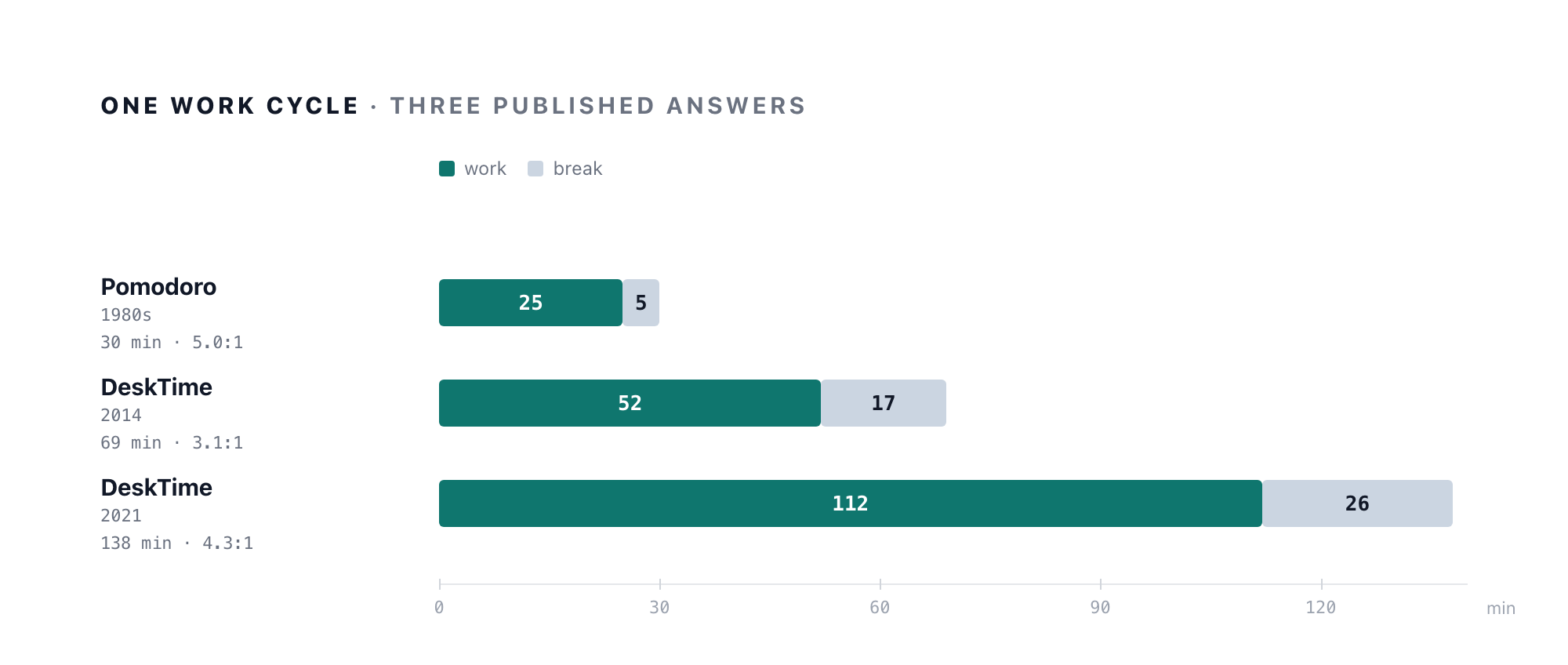
Three published recommendations for a single work cycle. The shortest is 30 minutes and the longest is 138 — a factor of 4.6, between three sources that all claim to describe how people actually work best.
II. What a countdown does that a clock cannot
If the number is arbitrary, why does a timer work at all? Because its job is not measurement.
A clock tells you what time it is. A countdown tells you that something will end. Those are different kinds of information, and only the second one changes behaviour.
The mechanism has been documented since the 1920s. In a series of experiments, the psychologist Bluma Zeigarnik gave participants a set of simple tasks and interrupted them partway through half of them. Later, asked to recall what they had done, participants remembered the interrupted tasks far better than the completed ones — roughly 68 per cent versus 43 per cent. Unfinished work stays in working memory; finished work gets released.
Read that finding backwards and you get the case for a timer. An open-ended task is an unfinished task by definition. "I'll work on this until it's done" gives your brain no point at which to file the work away, so it keeps holding it — and keeps interrupting you to check on it. A countdown supplies the missing boundary. At 10:25 the block is finished, whether or not the work is, and the task gets a provisional ending it can be filed under.
The mirror image is Parkinson's law — work expands to fill the time available. The two together describe a narrow corridor: too little structure and the task never closes, too much and it fills whatever you give it. A timer sets the width of the corridor.
Notice what the timer is not doing in either case. It is not tracking your productivity. It is not measuring how long the work "should" take. It is making one decision — when this ends — and then getting out of the way. Which means the specific number matters much less than the fact that there is one.
III. The evidence says the number moves
If a single ratio were built into human attention, independent studies would converge on it. They do not.
In 2014 the time-tracking company DeskTime published an analysis of its own users, isolating the top 10 per cent by productivity and looking at their computer usage across a workday. That group worked for about 52 minutes at a stretch, then took a break of about 17 minutes.
Seven years later DeskTime repeated the study with the same method and the same definition of "most productive" — and got 112 minutes of work followed by 26 minutes of rest. Nearly double, from the same company, measuring the same thing.
The company's own explanation is that the pandemic blurred the boundary between work and home, lengthened meetings, and changed the shape of a working day. That is a plausible account of the shift, and it is also the more important point: the number tracked the conditions, not the species. A ratio that responds to whether people are commuting is not a fact about cognition.
So three published answers now sit side by side: 25 and 5, 52 and 17, 112 and 26. All three are honest reports of what worked for a particular group at a particular time. None of them is a measurement of your attention, which has its own length, its own daily rhythm, and its own response to what you had for lunch.
IV. Sometimes the timer is the interruption
There is a second problem, and it comes from the person who has measured attention most carefully.
Gloria Mark, professor emerita of informatics at UC Irvine, has been tracking how long people stay on a single screen since before smartphones existed. Her first study, conducted in 2003 and published in 2004, found an average of two and a half minutes — 150 seconds — before people switched away. By 2020 the figure was 47 seconds, a result she says has been replicated across multiple studies between 2016 and 2020.
Recovering from an interruption, meanwhile, takes "almost half an hour."
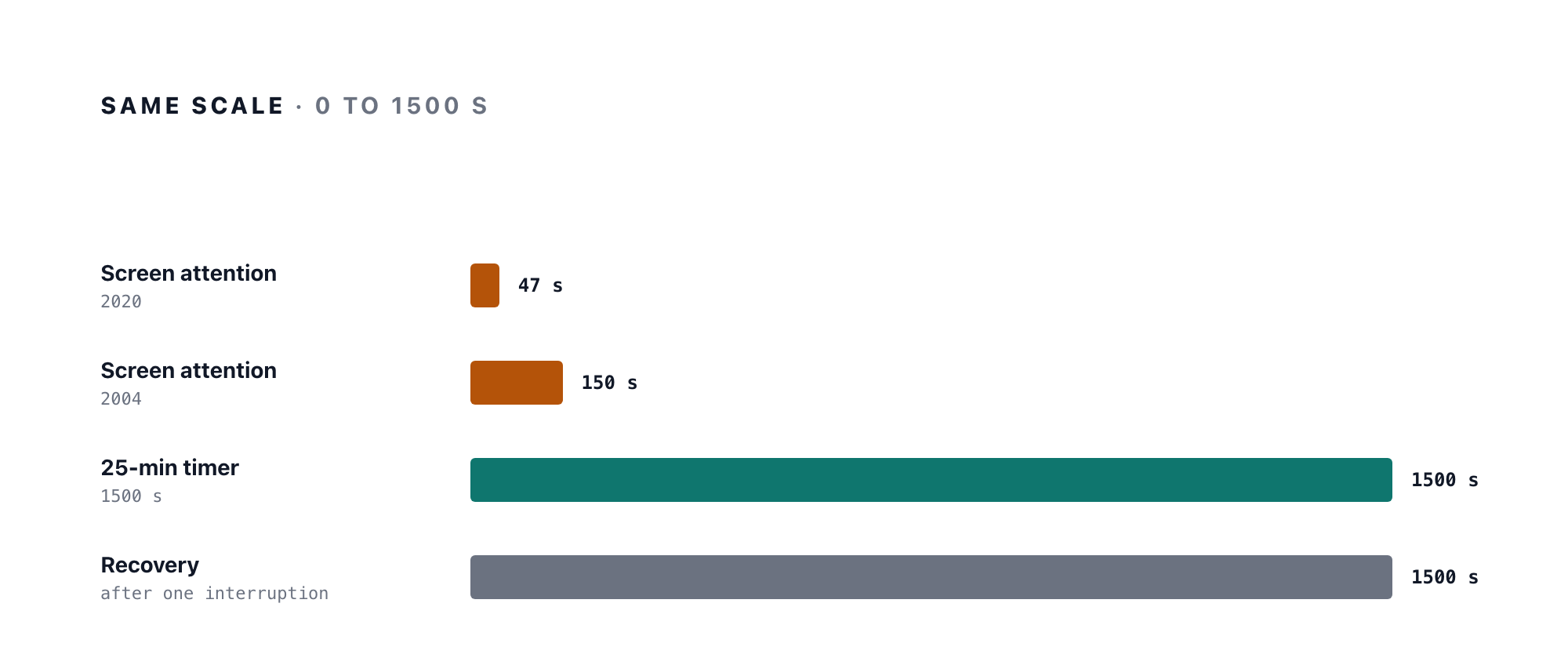
47 seconds is 3.1 per cent of a 1500-second block — the timer asks for roughly 32 times the average uninterrupted stretch. And one interruption costs about as much to recover from as the whole block is long.
Two things follow. First, a 25-minute block is not a modest ask; it is an order of magnitude beyond where most attention naturally lands, which is exactly why it feels like effort and exactly why it can work as training. Second, and less comfortably, Mark's own view of the technique is sceptical:
"The problem with the Pomodoro technique is that it is a 'one-size fits all' approach... a person may be on a roll in their task and then the 25-minute Pomodoro timer goes off and it's an interruption. It might be hard to reorient back to the task."
That is the trap in the method. A timer is supposed to protect your focus from interruptions; at the wrong moment it becomes one. If recovery costs as much as the block itself, a badly timed bell can consume the very attention it was meant to guard.
Her alternative is not another number. It is calibration: notice when your attention starts to thin, and break before that point rather than at a fixed interval. The timer becomes an instrument you tune, not a rule you obey.
One coincidence is worth flagging, because it gets conflated constantly. The 25 minutes in "25-minute Pomodoro" and the roughly 25 minutes it takes to recover from an interruption are unrelated quantities that happen to share a value. The first is a habit that stuck. The second is a measured cost. Do not read the overlap as a design insight.
V. How to find your own number
If the standard number is arbitrary, you need a procedure instead of a default. Four steps, in order.
Find your ceiling before you pick a target. Work on the task with no timer running and notice the first moment you feel the pull to check something else — a tab, a phone, a message. That moment is your honest ceiling. Set your first timer below it, not at it. A block you finish with attention to spare is worth more than a block you white-knuckle through, because it is the one you will repeat tomorrow.
Extend by five, not by twenty-five. If a block ends and you still had room, add five minutes next time. If it ends and you were already gone two minutes ago, subtract five. Two weeks of small adjustments will land closer to your real rhythm than any published ratio, because it is the only measurement taken on the only subject that matters here.
Count blocks, not minutes. Minutes are a vanity metric — anyone can sit near a task for an hour. The useful number is how many blocks you actually completed, meaning you started, stayed, and stopped at the bell. If that count is falling, your block is too long, no matter what the ratio says.
Set the break with the same seriousness as the work. This is the step people skip, and it is the one that decides whether the system survives a week. Mark's advice is to break before exhaustion rather than after, which means the break is not a reward for finishing — it is part of the block's design.
And one exception to all four: if the bell rings while you are genuinely in the middle of something, finish the thought. Not the task — the sentence, the function, the paragraph. Mark's point is that the interruption is the expensive part; you do not have to pay for it twice.
VI. Timer or stopwatch, depending on the question
A surprising amount of confusion comes from using the wrong instrument for the question being asked.
A timer counts down and answers "stop me at a certain point." A stopwatch counts up and answers "how long did that take." They look similar on screen and are not interchangeable.
The mistake shows up most often in estimation. Someone wants to know how long a report takes, so they set a 45-minute timer and start writing. What they learn is whether they can finish in 45 minutes — which is a fact about the deadline, not about the work. To learn the actual duration, you need the stopwatch: start it, forget it, and look at the number afterwards. Then the timer becomes useful, because now you have something real to set it to.
The rule of thumb: stopwatch first, timer second. Measure once, then schedule with the measurement. Running it the other way around produces a schedule built on optimism, and optimism is the one input that never gets logged.
Our stopwatch is the counting-up counterpart to the timer, and it records laps if you need to see where a long task actually went.
VII. What the tool actually has to do
If you searched for a timer and landed here, the practical part is short.
The online timer opens with five minutes loaded and eight presets within reach — 5, 10, 15, 25, 30, 45, 60 and 120 minutes — with 25 already labelled as the Pomodoro default. Press space to start, R to reset, S for settings, F for fullscreen. The countdown renders as a flip clock, which is a small thing that turns out to matter: a mechanical flip is legible from across a room, which is the entire point of putting a timer where you can see it.
Two settings are worth turning on deliberately. Auto-repeat restarts the block when it ends, which is what makes a focus session a session rather than a single attempt. Sound is on by default and the alert takes over the screen, so you can work with the tab in the background and still catch the end.
There are honest limits, and they are worth knowing before you plan around them:
- The maximum duration is 23:59:59. If you need a longer countdown, that is a calendar problem, not a timer problem — use days until instead.
- It is one timer at a time. No parallel timers, no lap list.
- Browsers throttle background tabs. If the exact end moment matters, keep the tab visible — this is true of every browser-based timer, not just this one.
If you already know your number, the fixed-duration pages skip the setup entirely: /timer/25-minutes and /timer/50-minutes open with the clock already loaded, which is what you want when you are starting a block rather than configuring one.
VIII. A timer is a decision you make once
Come back to the search box. The appeal of typing "25 minute timer" is not the number. It is that the decision is already made — you do not have to negotiate with yourself about when to stop, because a machine has taken that job and will not be talked out of it.
That is what the timer is for, and it is why the number can be almost anything. Twenty-five is not a law of attention. It is a default that outlived its origin, got promoted to a rule, and now sits in a search box waiting to be typed. It works — not because it is correct, but because it is decided.
The useful move is to take the decision back. Measure once with a stopwatch. Find the length where your attention actually runs out. Set the timer below that, and set the break too. Then stop thinking about the number, because the whole value of a timer is that it lets you stop thinking about time.
Start with 25 minutes if you want the default. Change it the moment you have better information about yourself — which, if you follow the four steps above, will be in about two weeks.
References
- Pomodoro® Technique — What Is The Pomodoro Technique — Cirillo's original two-minute experiment, the tomato-shaped kitchen timer, and the method's own framing of 25 minutes as adjustable
- How to sharpen your attention and meet your goals in 2024 — UC Newsroom interview with Gloria Mark: 150 seconds in 2004, 47 seconds by 2020, recovery "almost half an hour," and her critique of fixed-interval timers
- Productivity Research: overview of DeskTime's best finds — the 2014 52/17 finding from the top 10 per cent of users, and the 2021 replication at 112/26
- Zeigarnik effect — the 1927 interrupted-task experiments and the recall gap between finished and unfinished work