CST Is Three Different Times
Someone writes "CST 3pm" in a meeting invite and sends it to a group spread across three countries.
In Beijing the calendar resolves it to 15:00. In Chicago the same string means 01:00. In Havana it means 02:00. Three people, one line of text, three different hours — and nobody in the thread has misread anything. All three are correct readings of "CST".
The gap between the first and the last is fourteen hours. That is not a rounding difference or a daylight-saving edge case. It is the width of a working day, sitting inside three letters that everyone involved believed were unambiguous.
This is not a story about careless people. It is a story about a notation that was designed for a world where the reader already knew where the writer was sitting.
I. Three letters, four places
CST is the most crowded abbreviation in the system, but it is not unusual.
| Abbreviation | Full name | Offset |
|---|---|---|
| CST | China Standard Time | UTC+8 |
| CST | Cuba Standard Time | UTC−5 |
| CST | Central Standard Time (North America) | UTC−6 |
| CST | Central Standard Time (Central America) | UTC−6 |
Four names, three offsets — and CST is also widely used as a variant of ACST, Australian Central Standard Time, which adds a fourth offset at UTC+9:30.
IST is tidier but no less ambiguous: Indian Standard Time at UTC+5:30, Israel Standard Time at UTC+2, Irish Standard Time at UTC+1. Three names, three offsets, one string.
BST gives Bangladesh Standard Time at UTC+6, Bougainville Standard Time at UTC+11, and British Summer Time at UTC+1.
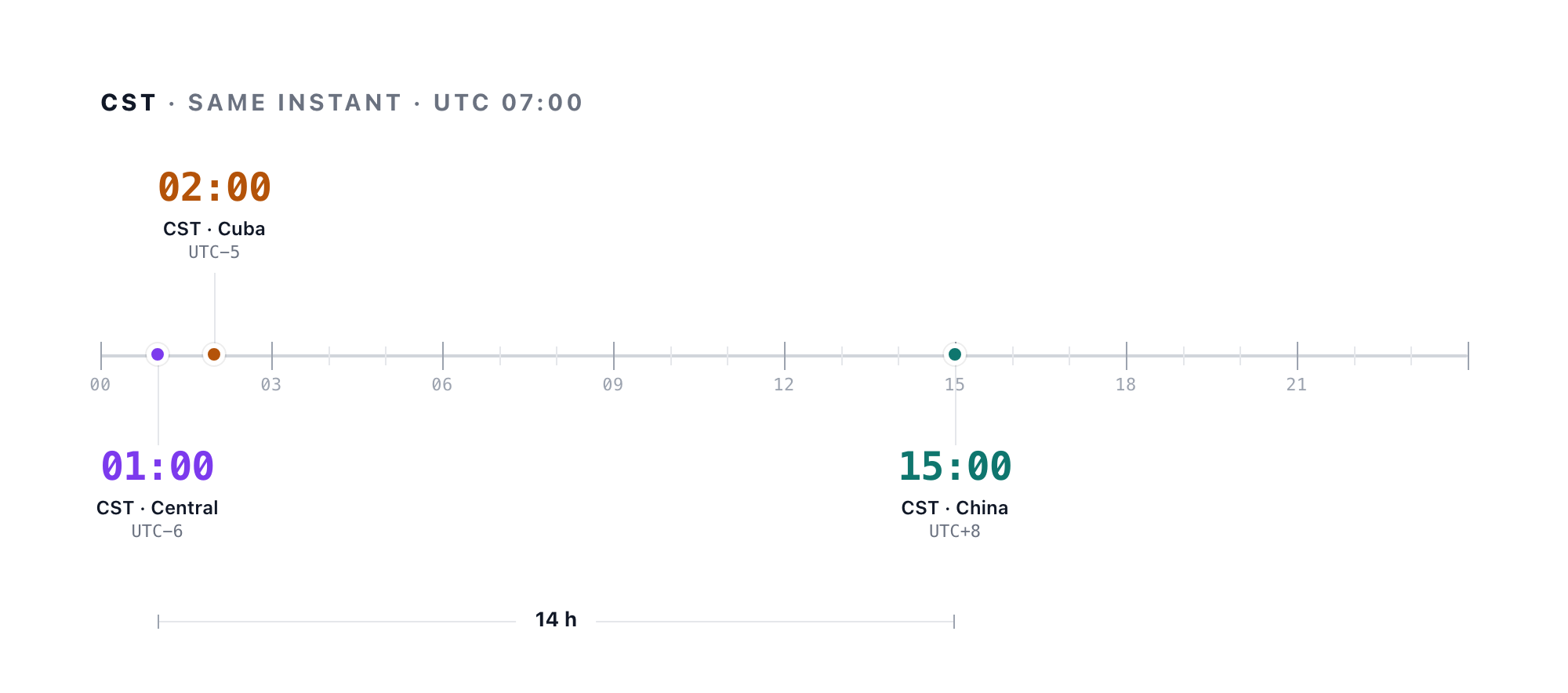
The same instant, three correct readings of one abbreviation. The distance between the first marker and the last is 14 hours: 15:00 minus 01:00.
None of these are typos or legacy oddities kept alive by accident. They are all in daily use, in official documents, in flight schedules and in calendar invites.
II. The abbreviation was built for a local audience
Time zone abbreviations were not designed to travel. They were designed to be read by someone standing nearby.
The format comes out of the railway age. When American railroads divided the continent into four standard zones in 1883, they needed short labels for timetables — something a station clerk could print in a narrow column and a passenger could scan in a second. "CST" did that job well, because everyone reading that timetable was in the same zone.
The same logic held for telegrams, business letters and shipping notices. The abbreviation worked because the context was implicit. If a letter arrived from Chicago saying "CST", the reader in Chicago knew what it meant, and the reader in New York could infer it from the postmark.
That is the actual function of an abbreviation: it points at context rather than replacing it. Strip the context away and the pointer has nothing to point at.
The internet strips the context away by default. A message in a group chat, a ticket in an issue tracker, a comment in a shared document — none of them carry a postmark. The string arrives alone, and the reader supplies whatever context they happen to have. In Beijing that is UTC+8. In Chicago it is UTC−6. Both readers are being reasonable, and they are fourteen hours apart.
It is worth noting what never happened: no standards body ever ratified these codes. Time zone abbreviations are not part of ISO 8601, the international standard for representing dates and times. They grew up beside the standard, not inside it, and they were never assigned in a way that guarantees uniqueness.
III. An offset is not a time zone
The obvious fix is to stop writing "CST" and write the offset instead. That is better, but it is not complete, and the gap between "better" and "complete" is where most calendar bugs live.
An offset tells you what time it is in a place right now. A time zone tells you what time it will be there later, and what it was there last year. Those are different questions, and only the second one survives contact with daylight saving.
RFC 9557, published in 2024, is the standard that finally made this explicit in internet timestamps. It extends the familiar RFC 3339 format with an optional bracketed zone name:
1996-12-19T16:39:57-08:00[America/Los_Angeles]
The offset and the zone name are both present, and they are not redundant. The offset pins down this instant; the zone name tells software how to move to other instants.
The specification is blunt about what goes wrong without it. A timestamp written as 2020-01-01T00:00+01:00[Europe/Paris] can be advanced by six months and land correctly in July, when Paris is on UTC+2. The same timestamp written as 2020-01-01T00:00+01:00[+01:00] — a fixed offset pretending to be a zone — will land an hour wrong, because it has asserted that Paris never changes its clocks.
The RFC's wording is worth quoting directly: programs must not copy the UTC offset from a timestamp into an offset time zone, because doing so "will improperly assert that the UTC offset of timestamps in that location will never change."
That sentence describes a whole class of production bugs. A meeting scheduled for "next quarter" from a fixed offset will be an hour off if the zone observes daylight saving and the quarter crosses a transition. The offset was correct when it was recorded and wrong by the time it was used.
IV. Where the half hours come from
If abbreviations are unreliable, the offsets themselves look arbitrary: why is India at UTC+5:30 and Nepal at UTC+5:45, instead of whole hours like most of the world?
The arithmetic is simple. The Earth turns 360 degrees in 24 hours, so it turns 15 degrees per hour — and one degree is four minutes. A time zone offset is just a longitude divided by 15.
India's standard meridian runs at 82°30′ east, which is 82.5 degrees:
82.5 × 4 = 330 minutes = 5 hours 30 minutes.
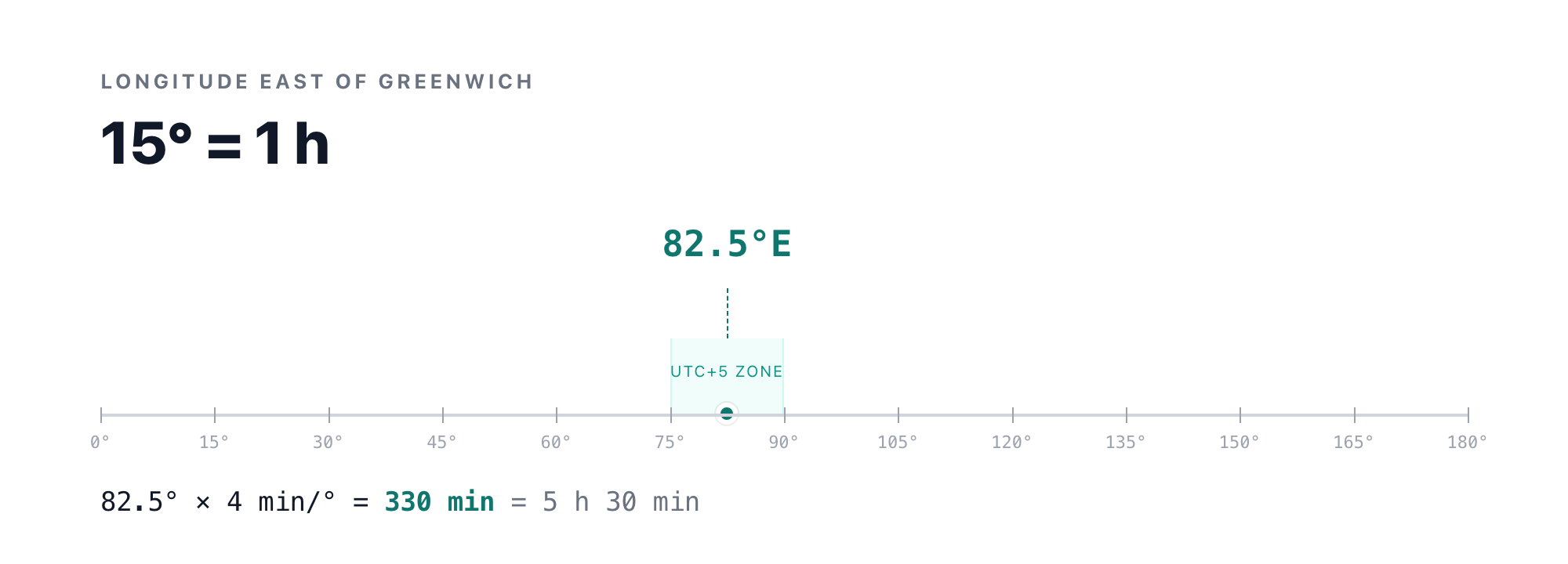
One degree of rotation is four minutes. A country that picks a meridian between whole hours inherits a fractional offset — geography, not rounding.
The meridian was chosen because it sits roughly midway between India's western and eastern extremes. India spans about 29 degrees of longitude, which is 116 minutes — nearly two hours of solar time between the far west and the far east. Picking a central meridian splits the inconvenience instead of dumping it on one end of the country.
Nepal took the same logic one step further. Kathmandu's mean solar time is UTC+5:41:16. Rather than round to UTC+5:30, Nepal advanced its clocks by 15 minutes in 1986 and settled on UTC+5:45 — close to local solar time, and deliberately not aligned with India next door.
Only three time zones in the world use a 45-minute offset: Nepal at UTC+5:45, the Chatham Islands at UTC+12:45, and an unofficial zone in western Australia at UTC+8:45. Fractional offsets are rare, but they are not errors. They are what happens when a country decides that local noon should mean something.
V. A time zone name is a political decision
The fractional offsets come from geography. Most of the rest comes from politics.
China is the clearest example. From 1918, and formally from 1947, the country was divided into five zones: Kunlun at UTC+5:30, Sinkiang-Tibet at UTC+6, Kansu-Szechwan at UTC+7, Chungyuan at UTC+8, and Changpai at UTC+8:30. The spread from west to east was three hours.
In 1949 the new government consolidated the country onto a single offset, UTC+8 — Beijing time — and the five zones disappeared. Xinjiang, in the far west, kept switching: between 1969 and 1986 it moved back and forth between its own UTC+6 and Beijing's UTC+8 several times before settling on Beijing time.
China also observed daylight saving from 1986 to 1991, then stopped. So "China has no daylight saving" is true now, was false for six years, and is a fact about policy rather than about the sun.
India's history runs the same way. Before a single standard was adopted on 1 January 1906, the subcontinent ran on at least three official times: Bombay Time at UTC+4:51, Calcutta Time at UTC+5:53:20, and Madras Time at UTC+5:21:14. Bombay kept its own time until 1955 — forty-nine years after the national standard existed.
The lesson is not that these countries were disorganised. It is that a time zone is an administrative boundary, not a geometric one. The offset of a place is whatever its government last decided, and governments change their minds.
This is also why the IANA database uses city names rather than country names. Asia/Shanghai covers the whole of China, not just Shanghai — the name marks the zone's origin, not its extent. Anyone reading it as "the time in Shanghai" has the right answer for the wrong reason.
VI. Two naming systems in one machine
Even after you decide to use zone names, there is one more trap: the two biggest operating systems do not use the same names.
The IANA database — the one behind nearly every server, phone and programming language — calls China's zone Asia/Shanghai. Windows calls the same zone China Standard Time. Both are correct within their own system, and neither is valid in the other.
The practical consequence shows up in data pipelines. A service writes China Standard Time into a database because it runs on Windows; a reporting job reads it on Linux and cannot resolve it, so it silently falls back to UTC. The timestamps are then eight hours off, and nothing throws an error.
The fix is a rule rather than a technology: store IANA names at rest, convert at the edges. IANA names are the closest thing the industry has to a universal identifier, they are maintained in public, and every language and database can resolve them.
VII. How to write a time that survives the trip
Three rules cover almost every case.
Write the offset, not the abbreviation. 09:30 UTC+8 cannot be misread. 09:30 CST can be misread in three different ways. If you are typing into a field that only accepts text, the offset is the minimum viable form.
Add the zone name when the time will be used later. For anything scheduled, recurring or stored, write 09:30 Asia/Shanghai. The offset is correct today; the zone name stays correct across daylight-saving transitions and future rule changes.
Never send a bare abbreviation across a border. Inside one country, in a channel where everyone already knows the geography, "CST" is fine and always has been. The moment the message crosses a border, the abbreviation has to be expanded.
For meetings specifically, the reliable move is to stop writing times in prose at all. Send an invite with a real time zone attached, or use a converter that shows both sides at once. Our time zone converter and world clock exist for exactly this: pick two cities, see the overlap, and check what happens across a daylight-saving boundary before you commit.
For contracts, name the zone and the offset together, and say which one governs if they ever disagree. "5:00 pm Beijing time (UTC+8)" is unambiguous today and will still be unambiguous after the next rule change.
VIII. The abbreviation is a claim about shared context
Go back to the invite. Three letters, three correct answers, fourteen hours of separation. Nobody was careless. The notation simply promised something it could not deliver: that the reader and the writer share a place.
That promise held for a century, because most messages did not travel far. A railway timetable, a telegram, a letter with a postmark — each carried its own geography with it. The internet removed the packaging and kept the label.
So the useful way to read "CST" is not as a time zone at all, but as a claim: the sender believes you already know where they are. Sometimes that claim is true. When it is false, the cost is not a confusing meeting — it is a missed flight, a broken deploy window, a contract argued over by two lawyers who are both reading the document correctly.
A time is never just a number. It is a number plus a place. Abbreviations are an attempt to leave the place out, and that is precisely why they fail.
References
- List of time zone abbreviations — every meaning of CST, IST and BST, with offsets
- RFC 9557: Date and Time on the Internet: Timestamps with Additional Information — the bracketed zone-name annotation and why a fixed offset cannot do the job
- Time in China — the five pre-1949 zones, the 1949 consolidation, and the 1986–1991 daylight saving period
- Indian Standard Time — Bombay, Calcutta and Madras time, and the 82°30′ meridian
- Nepal Standard Time — Kathmandu mean solar time and the 1986 move to UTC+5:45
- Default Time Zones — Microsoft's Windows time zone identifiers, including
China Standard Time