Military Time: What the Four Digits Actually Encode
1830 is half past six in the evening. Anyone can learn that conversion in thirty seconds.
But real military time is not "the 24-hour clock written more compactly." It is an encoding designed for a voice channel: fixed width, no separators, no AM or PM, optionally followed by a zone letter. Each of those constraints exists for a reason, and removing any one of them breaks something downstream.
This article is about the encoding itself — why it looks the way it does, and where it diverges from the civilian 24-hour clock.
I. Military time is not the 24-hour clock
The two terms are often used interchangeably. They are not the same thing.
The 24-hour clock is the most widely used time format in the world: train timetables across continental Europe, flight information in China, TV listings in Japan, computer logs, ISO 8601. Military time is a restricted subset of it, used by armed forces, emergency departments, aviation, and emergency services.
The difference comes down to a few extra rules:
| 24-hour clock | Military time | |
|---|---|---|
| Separator | 18:30 allowed | Not written — 1830 only |
| Length | Variable, 9:05 is valid | Fixed at four digits, 0905 |
| Meridiem | Implied by the hour | Implied by the hour, and AM/PM is forbidden |
| Time zone | Usually absent | Optional letter suffix, 1830Z |
That third rule is the one people miss: 1830 PM is wrong in a military context. The hour already settles the question. Adding a second marker only creates the possibility of contradiction — and if the two disagree, which one is the recipient supposed to trust?
Why only Americans call it "military time"
Because Americans coined the phrase.
In continental Europe, China, Japan, and Korea, the 24-hour clock is simply how time is written. A train ticket says 15:57. A TV listing says 21:00. Nobody needs a special name for it.
The United States is different. Its civilian life runs on the 12-hour clock; its military runs on the 24-hour clock. Two systems coexist, so a word is needed to tell them apart. And that split formed remarkably late: the U.S. Navy adopted the 24-hour clock in 1920, and the Army did not follow until 1942. Before that, American military timekeeping was not even internally consistent.
So "military time" does not record a military tradition. It records a specifically American piece of two-track history.
II. Why four digits
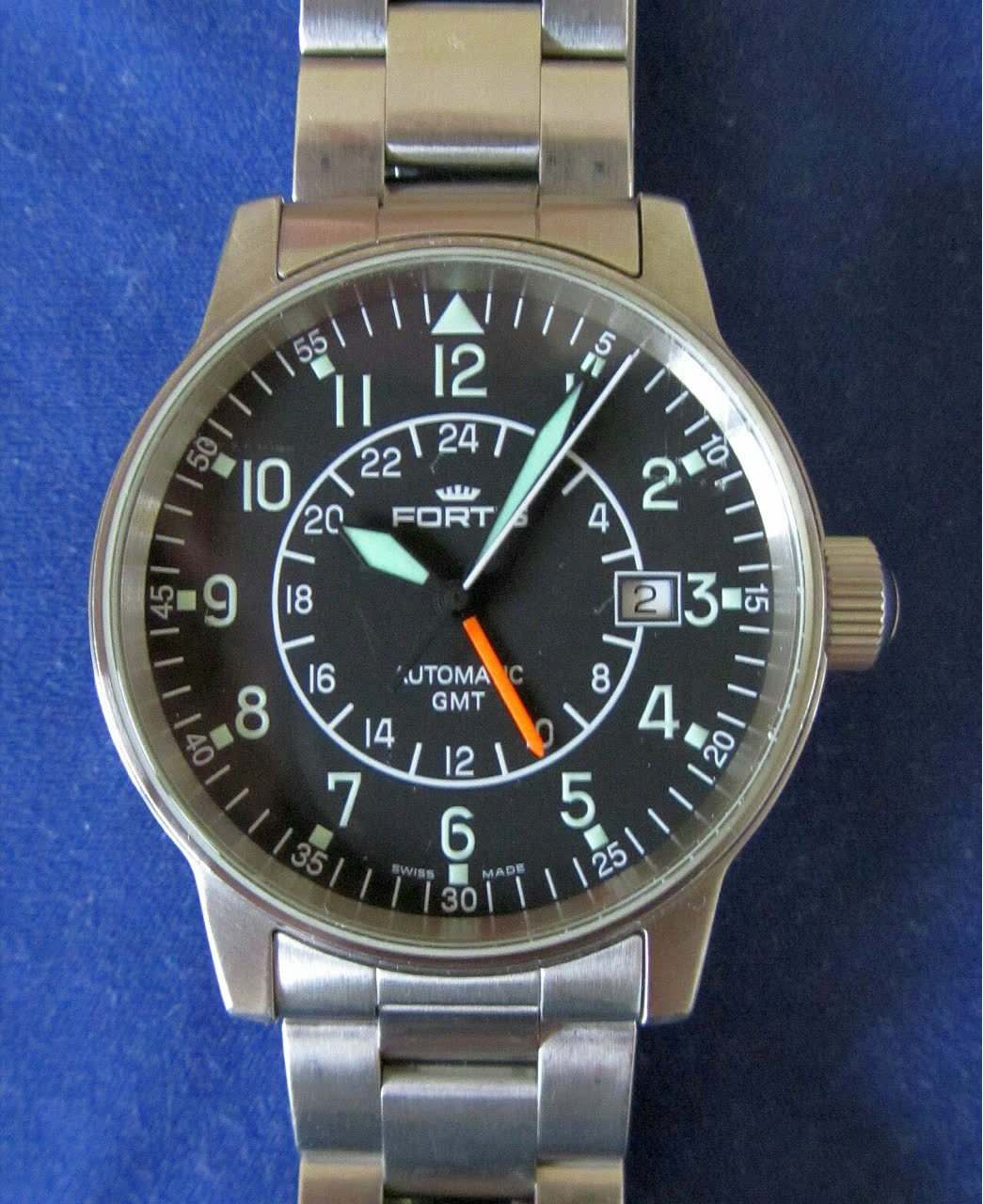
A Fortis Flieger GMT. The inner 24-hour ring lets the wearer read both scales without doing arithmetic. CC0 image via Wikimedia Commons
Four digits is not an aesthetic choice. It is a communications requirement.
Fixed width is self-checking. In a voice message, if the time field is always four characters, the receiver can locate it by length alone. "Seventeen thirty" is four syllables. "Five thirty" is two — and if noise eats one of them, you are left with "thirty," which means something else entirely. Four digits minimize the part that can be lost.
Fixed width sorts correctly. In a string sort, 0905 comes before 1830, and 1830 before 2359 — lexicographic order happens to equal chronological order. The 12-hour clock cannot do this: sort 9:05 AM and 6:30 PM as strings and you get the wrong answer.
Fixed width parses cleanly. This is the same property in its modern form, with a program instead of a person on the receiving end: log lines, message formats, database columns.
There is a well-worn story about what the rule costs when you skip it. Sandford Fleming, the 19th-century Canadian railway engineer, missed a train in Ireland because a timetable had printed pm where it meant am. He went on to become one of the most persistent advocates for both the 24-hour clock and standard time zones.
The anecdote's finer details are hard to verify now, but the problem it points at is real: the 12-hour clock puts a binary piece of information — morning or afternoon — at the end of the string, while human eyes scan from the front.
III. Where the day ends: 0000 and 2400
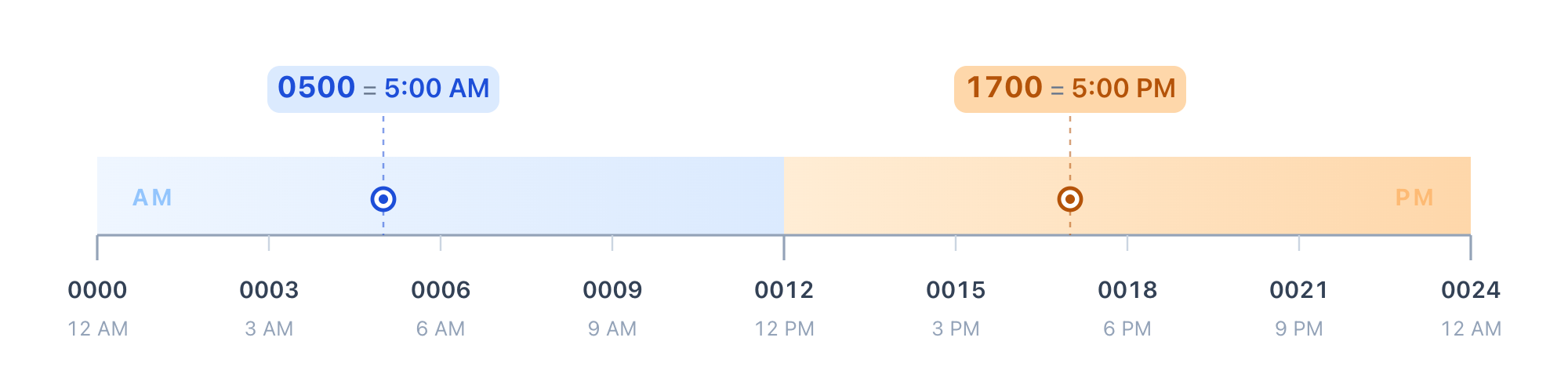
In military usage, the day runs from 0000 to 2359. There is no 2400.
This is one place where military practice and the civilian 24-hour clock genuinely disagree:
- ISO 8601 permits
24:00, specifically to mark the end of a day. On a timetable, the slot after 23:59 and before the next day's 00:00 is less likely to be misread as tomorrow if you write24:00. - Military usage does not write
2400. United Nations military observer training material is blunt about it: midnight is always0000, always spoken "zero hundred hours," and never2400.
Both conventions have a rationale. ISO's 24:00 answers "is this the last train today or the first train tomorrow?" The military's 0000 answers "there is exactly one midnight in this message." Military traffic is sorted chronologically, and if today's endpoint and tomorrow's start point are two different strings, the sort breaks.
The military time converter on this site sides with the military convention: enter 2400 and you will not get 12:00 AM back. You get told, plainly, that midnight is 0000, not 2400 — and that 2400 only marks the instant a day ends.
IV. Saying it out loud
The written rules are easy. The spoken rules are the real barrier. There are four.
Full hours take "hundred." 1500 is "fifteen hundred," 2300 is "twenty-three hundred." It is not "fifteen thousand" — 1000 is "ten hundred," not "one thousand."
Single-digit hours take a leading "zero." 0900 is "zero nine hundred," not "nine hundred." 0100 is "zero one hundred." The only exception is 0000 itself, which is "zero hundred."
Times past the hour drop "hundred." 0530 is "zero five thirty," 1615 is "sixteen fifteen." Adding "hundred" here is an error.
Minutes below ten take "oh." 0905 is "zero nine oh five." The "oh" is the letter O, not the digit zero — which is why reading 0905 as "nine five" loses a digit outright.
Put together: 1830 is "eighteen thirty," 0605 is "zero six oh five," 0000 is "zero hundred."
V. That letter at the end
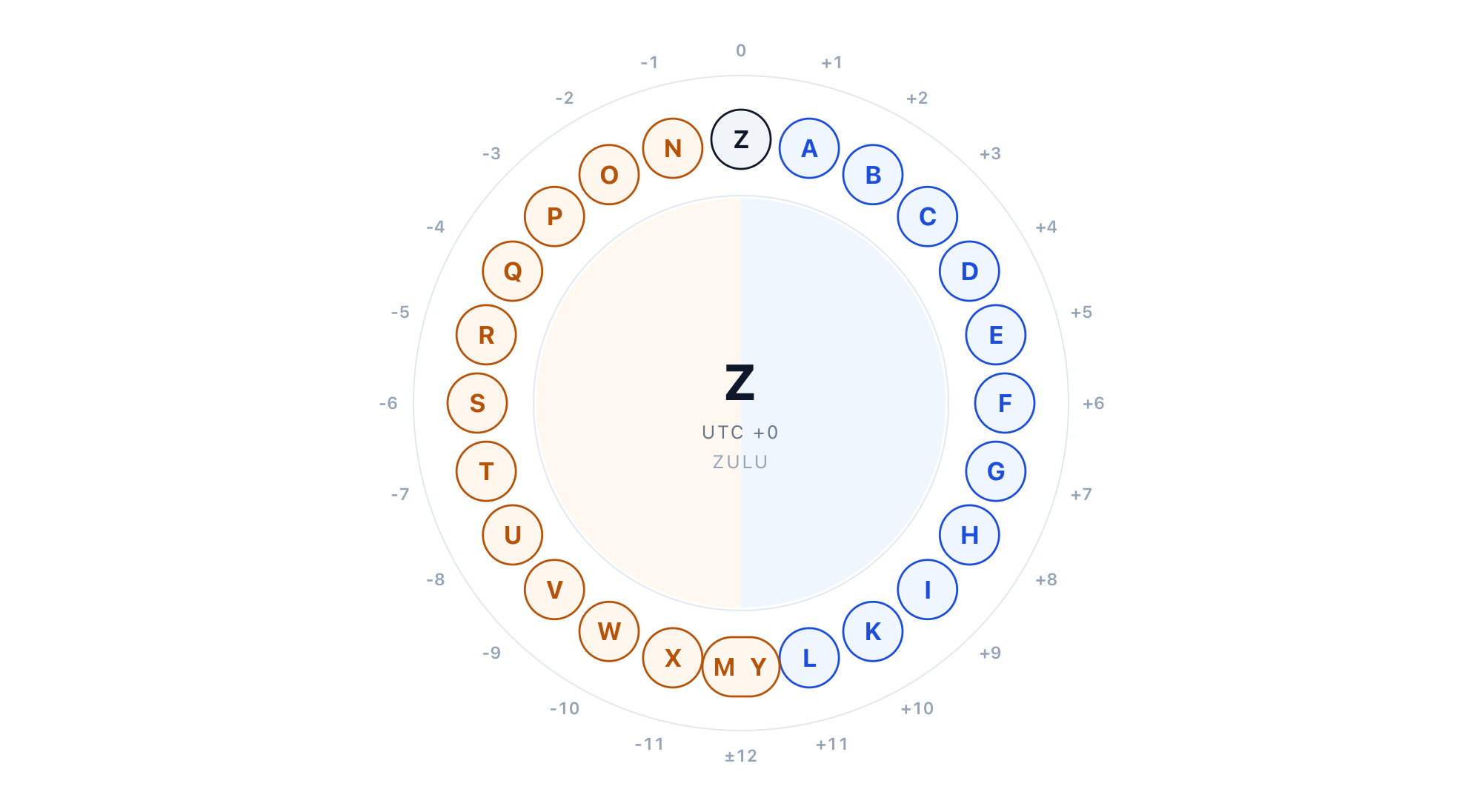
Four digits say what time. They do not say in which zone. Military time adds that layer with a single letter.
The rule is simple: Z sits on the prime meridian. Going east, one letter per 15°, A through M (skipping J). Going west, N through Y. Twenty-five zones in all.
Three details deserve their own paragraph.
J is unassigned. It denotes the sender's own local time, and therefore points at no fixed offset. That is also why A through M is thirteen letters covering only twelve zones.
M and Y are the same line. M is UTC+12, Y is UTC−12, and they sit on the same meridian. The only difference is the date: M is a day ahead of Z, Y is a day behind. This is precisely why the International Date Line has to zigzag through that stretch of the Pacific.
Z is spoken "Zulu." The letters come from the NATO phonetic alphabet, not from letter names. So 1830Z is "eighteen thirty zulu" and 1530R is "fifteen thirty romeo" (R being UTC−5). The code words exist to separate letters that sound alike over a bad channel — M and N are nearly indistinguishable spoken plainly, while "Mike" and "November" are not.
A common misconception: military time does not mean UTC. Only a Z suffix means UTC. Tactical traffic uses local zone letters constantly; only cross-theatre coordination standardizes on Z. A message reading 1530R means 3:30 p.m. Eastern, not 15:30 UTC.
VI. The full timestamp: DTG
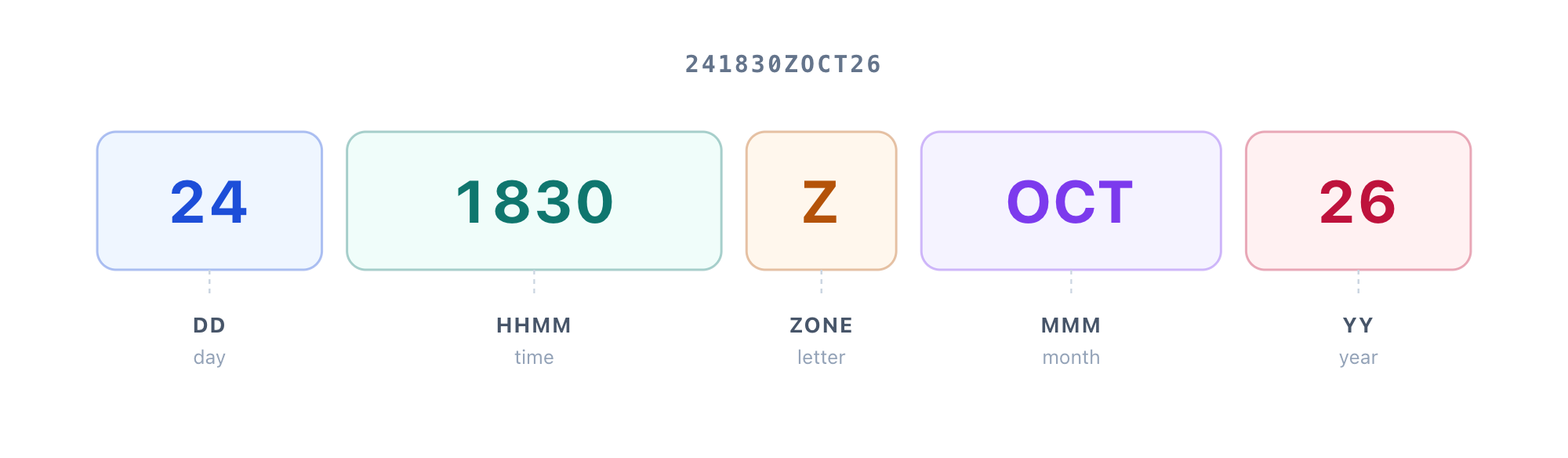
Compress a date and a time into one string and you have a Date-Time Group (DTG), the standard format in NATO and U.S. military message traffic:
DDHHMMZMONYY
241830ZOCT26 reads: 24 October 2026, 18:30, Zulu time.
Five fields, no separators at all — no colons, no slashes, no spaces. This is not merely about saving space (though it does). It makes the whole string an indivisible token: either it is complete, or it is invalid. There is no half-correct state where a colon went missing.
Two conventions are easy to overlook:
Months are three uppercase letters, JAN through DEC, never digits. The reason is that 03 and 04 can be confused on a low-resolution display or in handwriting, while MAR and APR cannot.
Years are two digits. This is a legacy of an era when storage was expensive. It works in military traffic, where messages have retention limits. Treat it as a general-purpose format and it breaks: whether 26 means 2026 or 1926 depends entirely on context.
Some messages write 0001 rather than 0000. When the author wants to stress "the very start of this day, unambiguously past midnight," 0001 does the job. 0000 sits on a boundary and always carries some ambiguity; 0001 does not.
VII. Five common mistakes
- Writing
2400. It does not exist in military usage. The day ends at2359; the next begins at0000. - Adding a colon.
18:30is civilian style,1830is military. Mixing them causes no confusion for a human, but it fails format validation. - Saying "oh hundred."
0000is "zero hundred." "Oh" belongs to the minutes place (0905→ "oh five"), never the hours. - Saying "thousand."
1000is "ten hundred." In English, "thousand" names a quantity, not ten o'clock. - Assuming military time means UTC. Only a
Zsuffix does.1530Ris 15:30 at UTC−5.
VIII. Beyond the military
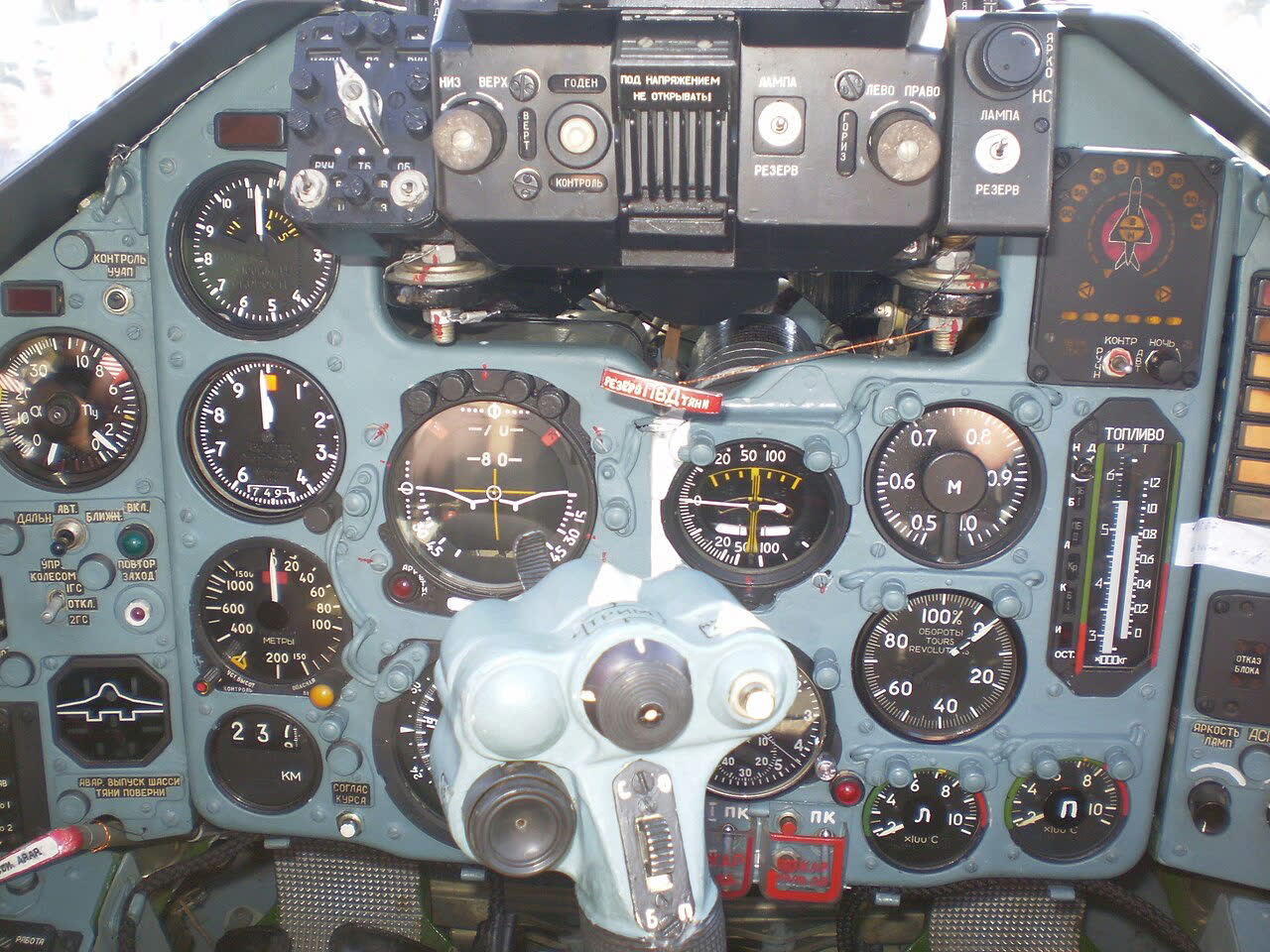
A Su-25 cockpit. Military aircraft generally use 24-hour instruments so pilots never have to resolve an AM/PM question under pressure. Public domain image via Wikimedia Commons
The 24-hour clock reaches further into civilian life than most people assume:
- Aviation: schedules, flight plans, and air traffic control all use UTC, written
1830Z. - Medicine: emergency records, medication times, and bedside monitors.
- Emergency services: fire and rescue response logs. The U.S. Fire Administration's incident reporting standard (NFIRS) explicitly requires 24-hour time in its time fields.
- Computing: log files, ISO 8601, and the display layer of every timestamp.
What these settings share is not discipline. It is the cost of getting it wrong: a misread AM/PM can cost an aircraft its slot, or put a dose on the wrong hour.
What this site's tool does and does not do
The military time converter carries 61 individual time-point pages chosen by search volume, plus a chart covering all 48 half-hours from 0:00 to 23:30. Each time point gives the four-digit form, the 12-hour equivalent, and the spoken form.
It deliberately does not do two things:
- No zone-letter conversion. Times on the page are local times with no
A–Zsuffix. For cross-zone work, use the time zone converter or world clock. - No DTG generation. That requires a date, a time, and a zone as simultaneous input, which is beyond the scope of point-to-point conversion.
It is a converter, not a message generator. Knowing where the boundary sits is more useful than pretending there isn't one.
For a full conversion table between the two formats, 12-hour vs 24-hour time lays out the rules and the failure cases. This article is about the extra layers military time stacks on top.
References
- Encyclopaedia Britannica. 24-hour clock.
- Bikos, K. Military Time: The 24 Hour Clock. timeanddate.com.
- The Fight School. Military Time & The DTG. Training material for United Nations Military Observers (UNMC).
- The Fight School. Handout #02: DTG — Date Time Group Quick Reference Guide.
- International Organization for Standardization. ISO 8601-1:2019 — Date and time — Representations for information interchange — Part 1: Basic rules.
- International Civil Aviation Organization. Alphabet Radiotelephony.
- U.S. Fire Administration. National Fire Incident Reporting System (NFIRS-1) — Incident Report. FEMA.