The First Second of 2027 Takes 26 Hours to Arrive
There are 68 days until 1 January 2027. At midnight on that date, Christmas Island in Kiribati will be the first inhabited place to enter the year.
At that moment it will be 6 p.m. on 31 December in Beijing, 10 a.m. in London, and 5 a.m. in New York — Manhattan has just gone to bed, with nineteen hours still to go before its own countdown.
The last place on Earth to cross into 2027 will not get there until 26 hours later.
This particular New Year's Eve has something else going for it: it is the last one that could, in principle, contain a 23:59:60. On 15 October 2026, the 28th General Conference on Weights and Measures, meeting at Versailles, resolved to stop inserting leap seconds from 20 May 2027. That makes the night of 31 December 2026 the final New Year's Eve under a regime that still permits one — though the International Earth Rotation Service confirmed back in July that this one won't actually have it.
Two things to explain, then: why New Year takes 26 hours to go around, and where that spare second went.
I. Where the first second lands

Sydney's New Year fireworks. Sydney runs on UTC+11 in summer, three hours behind UTC+14. CC BY-SA 4.0, photo by Dicklyon, via Wikimedia Commons
The most advanced time zone in the world is UTC+14, used by the Line Islands of Kiribati. The main island is Kiritimati, better known in English as Christmas Island.
The zone is counter-intuitive. Kiritimati sits at roughly 157°W, which by the geometric rule of fifteen degrees per hour ought to be UTC−10. Kiribati moved it to UTC+14, effectively pushing the island across the International Date Line, so that the whole country shares a single date. The country spans 3,800 kilometres; without that adjustment, the capital Tarawa and the Line Islands would sit a full day apart, and every government circular, flight connection, and business transaction would have to be dated twice.
The cost is that Kiritimati shares an approximate longitude with Hawaii (UTC−10) while running a full day ahead on the calendar. Two places about 2,000 kilometres apart, clocks reading roughly the same hour, dates 24 hours apart.
So every 31 December, when Christmas Island starts counting down, Honolulu is still on 30 December.
II. Twenty-six hours
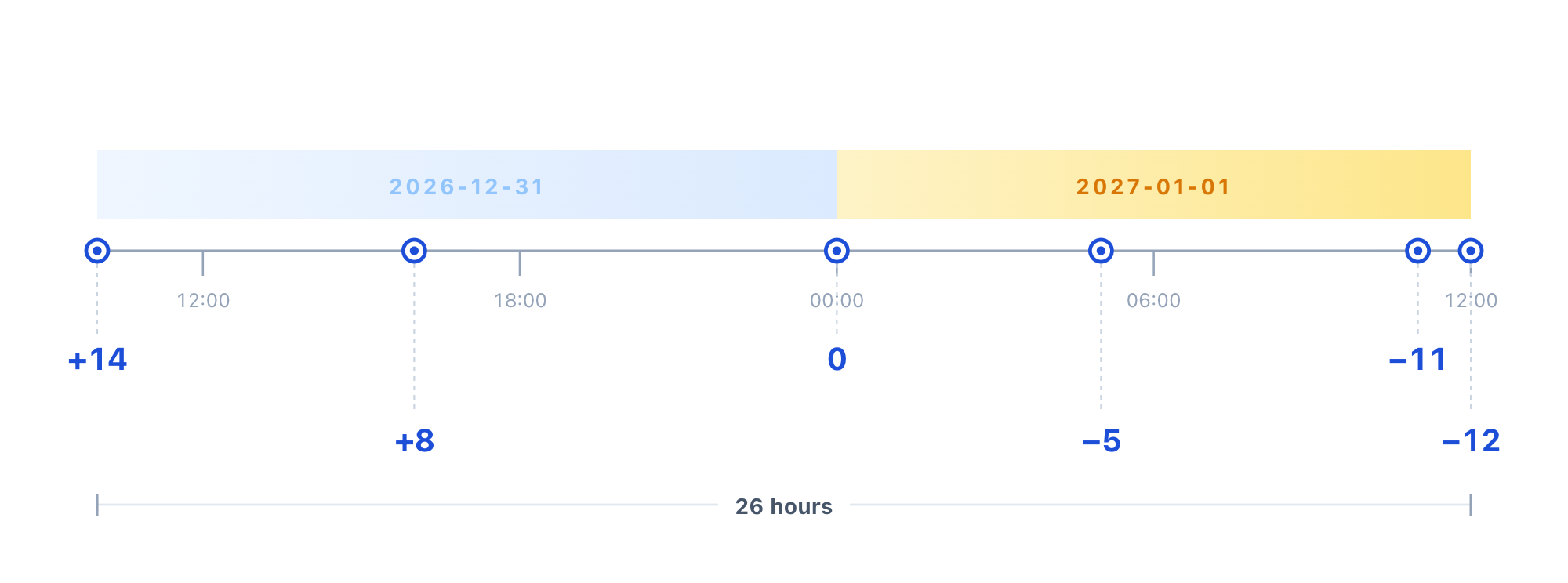
From midnight at UTC+14 to midnight at UTC−12 is 26 hourly offsets. That is where the 26 hours comes from.
The six dots on the diagram are representative points:
| Offset | Enters 2027 (UTC) | Beijing at that moment |
|---|---|---|
| UTC+14 | 31 Dec, 10:00 | 31 Dec, 18:00 |
| UTC+8 | 31 Dec, 16:00 | 1 Jan, 00:00 |
| UTC±0 | 1 Jan, 00:00 | 1 Jan, 08:00 |
| UTC−5 | 1 Jan, 05:00 | 1 Jan, 13:00 |
| UTC−11 | 1 Jan, 11:00 | 1 Jan, 19:00 |
| UTC−12 | 1 Jan, 12:00 | 1 Jan, 20:00 |
Look at that last column. When Beijing sets off its midnight fireworks, half the planet has not finished 31 December. And by the time Beijing is at 8 p.m. on 1 January, replaying the gala, the people of Baker Island are only just entering 2027.
New Year is not a simultaneous global event. It is a wave that sweeps across the planet. It advances westward at fifteen degrees of longitude per hour, taking 24 hours to circle the globe — except the zone boundaries are not straight and there are offsets beyond ±12, so the real span is 26 hours.
III. Where the last chime falls
Strictly speaking, UTC−12 is the final zone, used by Baker Island and Howland Island, both territories of the United States.
Neither has any permanent population. Baker Island is a 1.4-square-kilometre atoll with a Second World War airstrip, evacuated in 1942 after Japanese attacks and abandoned since. It is now administered by the U.S. Fish and Wildlife Service, open only to researchers, and marked by a daytime beacon.
So "the last place to celebrate New Year" has two answers:
- Geographically: Baker and Howland Islands (UTC−12), uninhabited.
- Among inhabited places: Pago Pago in American Samoa, Alofi in Niue, and Midway Atoll — all UTC−11. These run 25 hours behind UTC+14.
The gap between 26 and 25 hours is exactly that stretch of empty reef.
IV. 1 January was chosen, not given
New Year's Day is not an astronomical fact. A orbit has no starting point. Any day could have been called the first.
The Romans originally began the year in March — which is why September, October, November and December carry names meaning "seventh month" through "tenth month". The mismatch has survived into every calendar we use.
Later, Rome fixed 1 January as the day consuls took office. January (Januarius) was dedicated to Janus, the two-faced god who looks backward and forward at once — an image almost too well suited to a new year. 1 January gradually displaced March.
Then the Middle Ages reversed it. In England, from 1155 until 1752, the year began on 25 March — Lady Day, the Feast of the Annunciation. Dates between 1 January and 24 March still belonged to the previous year, which is why documents from the period are often dated "1731/32".
In 1582 Pope Gregory XIII promulgated the new calendar and fixed 1 January as the start of the year. Catholic states followed; Protestant states dragged their feet. England waited until 1752. Russia waited until 1918.
China was later still. On 27 September 1949, the First Plenary Session of the Chinese People's Political Consultative Conference adopted the Gregorian calendar, naming 1 January Yuandan and the first day of the lunar year Chunjie — the Spring Festival. Two new years, formally separated.
V. The eleven days that never happened
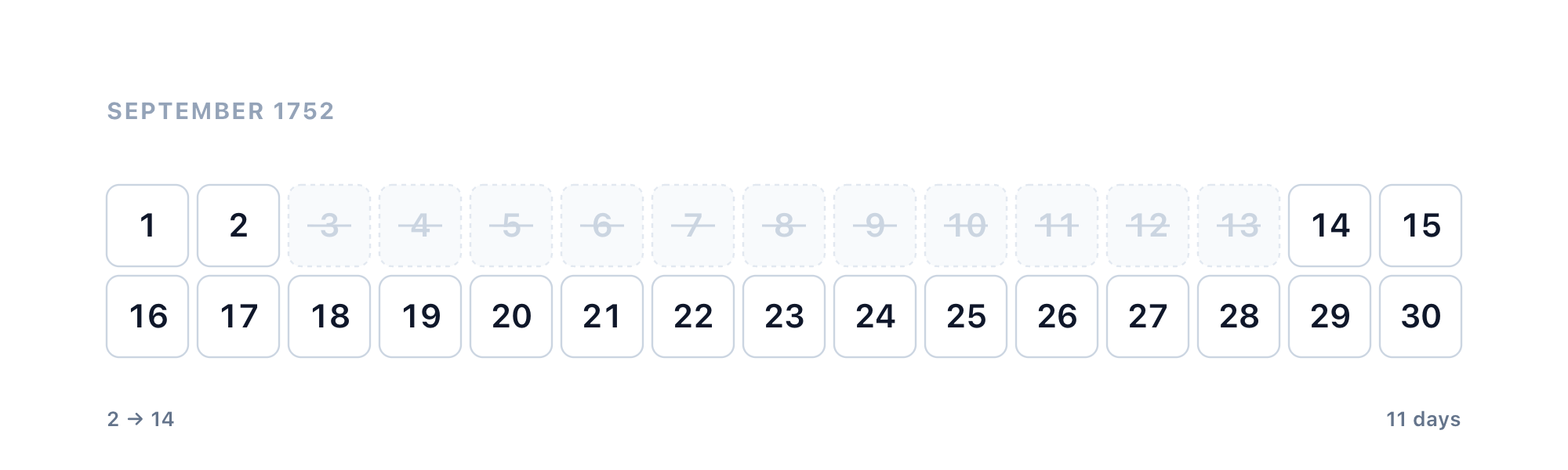
Calendar reform is not a matter of renaming. It requires erasing accumulated error in one stroke.
The Julian calendar, introduced by Julius Caesar in 45 BC, set the year at 365.25 days — about eleven minutes longer than the tropical year. Eleven minutes a year is invisible. Eleven minutes a year for sixteen centuries is ten days. By the 1500s the spring equinox had drifted from 21 March to 11 March, which meant Easter could no longer be computed correctly. That, rather than any abstract love of accuracy, was the immediate motive for reform.
The Gregorian rule — leap year every four years, except centuries not divisible by 400 — cuts the error to about one day in 3,000 years. But the days already lost had to be removed from the calendar.
In October 1582, Catholic countries skipped 5 through 14 October outright. England waited until September 1752, by which point the drift was eleven days, so Wednesday 2 September was followed directly by Thursday 14 September.
The public reaction was fury. "Give us our eleven days" became a slogan. Some people were convinced they had lost eleven days of their lives and demanded eleven days of wages. There are reports of riots, though historians disagree about how large they were; Benjamin Franklin's dry suggestion that the change cost eleven days of rent but also saved eleven days of debt has travelled better.
Russia came later still. After 31 January 1918 came 14 February, a jump of thirteen days. This is why the October Revolution is dated to November 1917: by the Russian calendar it was 25 October.
So New Year's Day has fallen on different dates in different countries, and when it moved, days were genuinely deleted from the calendar.
VI. A countdown is not a subtraction
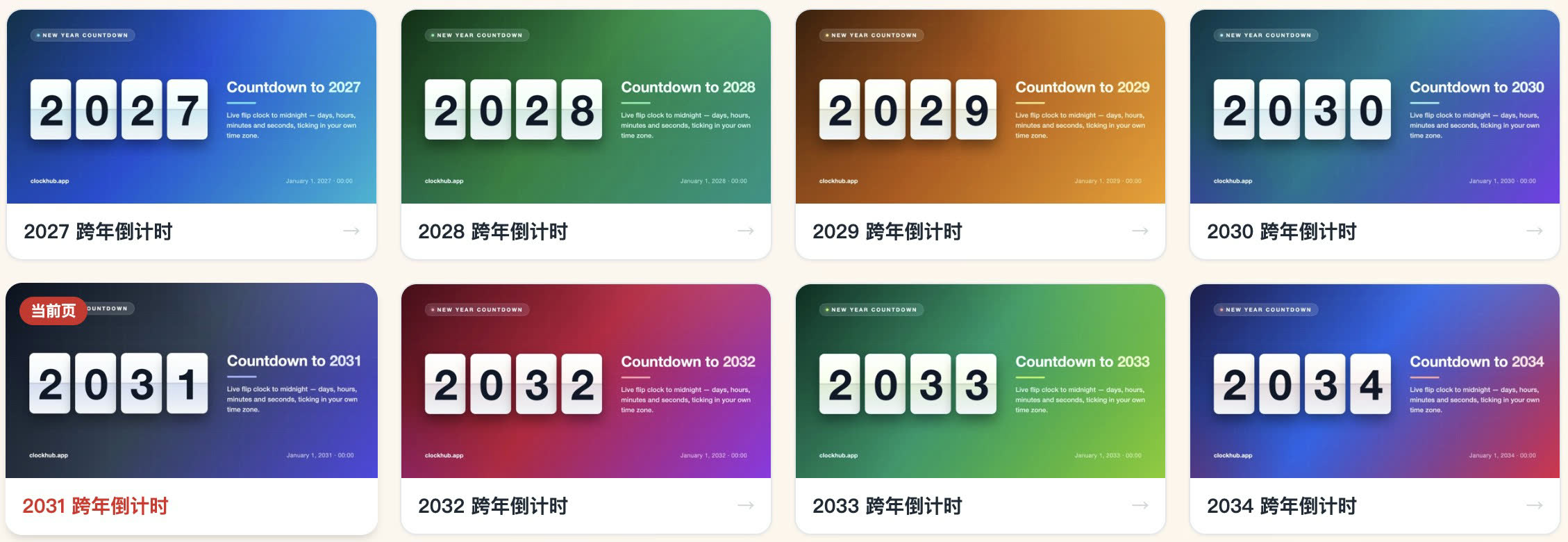
A New Year countdown looks like the simplest program in the world: subtract now from the target, refresh every second.
But it has to answer one question first: which midnight is the target?
The New Year countdown on this site answers "the midnight of your own time zone". The target is stored as 2027-01-01T00:00:00 — deliberately without a time zone suffix, so the browser resolves it in the visitor's local zone.
That is not laziness; it is the only correct choice. Use UTC and a user in Beijing would see "the new year has arrived" at 8 a.m. on 1 January, having already slept through the holiday. A countdown is supposed to synchronise with the world around you, not with Greenwich.
Two boundaries have to be handled as a result:
First, past years cannot simply be deleted. The pages for 2025 and 2026 remain reachable; the clock just stops at 00:00:00 and the page offers a link to the next year. Someone searching for "2025 New Year countdown" should land on that year's page, not be redirected to 2027.
Second, the page has to notice midnight on its own. The first client render computes from the build timestamp, then swaps in the real clock after mount — otherwise a statically exported page would visibly jump when it hydrates.
If you want to watch someone else's midnight, the world clock lists several cities at once; for specific conversions, use the time zone converter.
VII. The last 23:59:60
Back to where we started.
Since Coordinated Universal Time began in 1972, 27 leap seconds have been inserted, most recently on 31 December 2016. That night, clocks worldwide displayed 23:59:60 after 23:59:59.
Leap seconds exist because two kinds of second are not the same length. The atomic second is extraordinarily stable; the Earth's rotation is slowing. Left alone, the two would drift apart. To keep UTC within a second of Earth rotation time (UT1), a second is occasionally inserted or removed.
The trouble is that this second is expensive. When a leap second occurred in 2012, Reddit, Mozilla, LinkedIn and others had outages; aviation, finance and power engineers plan for it every time. The root cause is simple: most software assumes a minute has 60 seconds, and a leap second breaks that assumption.
Hence two decisions:
- On 6 July 2026, the International Earth Rotation and Reference Systems Service issued Bulletin C 72, confirming that no leap second would be inserted at the end of December 2026.
- On 15 October 2026, the 28th CGPM resolved at Versailles to adopt "continuous UTC" from 20 May 2027, widening the maximum permitted difference between UTC and UT1 from one second to 3,600 seconds — one hour.
The original plan was to complete this by 2035. It has been pulled forward by eight years.
Two consequences follow.
The night of 31 December 2026 is the last New Year's Eve under a regime that still permits a leap second. From 20 May 2027, no matter how the planet's rotation behaves, there will be no more 23:59:60.
And that final night will not contain one. The IERS has already said so. Strictly speaking, humanity's last New Year's Eve that could have had a leap second is one where even the possibility has been ruled out in advance.
When the gap between Earth and atomic clocks next needs correcting, it will be allowed to accumulate to an hour first — centuries from now, and by then the likelier fix is a "leap hour" or a redefinition, rather than a return to guarding every single second.
VIII. The countdown
Those 68 days will shrink. 1 January 2027 falls on a Friday, which in China means the holiday runs into the weekend without any make-up work days.
To see how many days are left right now, the countdown recalculates in your local zone. To see what time it is in New York when Sydney lights up, the world clock will show both at once.
As for that 23:59:60 — it is not coming. For the first time, humanity can state with certainty that a particular moment will never occur.
References
- Bureau International des Poids et Mesures. 28th General Conference on Weights and Measures (CGPM), Resolution on continuous UTC. Versailles, 13–15 October 2026.
- International Earth Rotation and Reference Systems Service. Bulletin C 72. 6 July 2026.
- timeanddate.com. The Future of Leap Seconds.
- timeanddate.com. Line Islands Time (LINT) — UTC+14.
- timeanddate.com. Julian to Gregorian Calendar: How We Lost 10 Days.
- Historic UK. Give Us Our Eleven Days — The English Calendar Riots of 1752.
- UK Parliament. Calendar (New Style) Act 1750.
- Encyclopaedia Britannica. Gregorian calendar.
- First Plenary Session of the Chinese People's Political Consultative Conference. Resolution on the calendar, national flag and national anthem of the People's Republic of China. 27 September 1949.